[Unpad.ac.id, 25/11/2013] To fight against violence to women, support is needed from many sides, not only from women as the victims, but also from men. A dialogue between both genders is highly encouraged to redefine the roles of men and women in order to eliminate gender-based violence in the future.
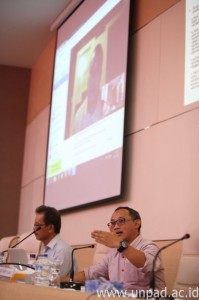
Eko Bambang Subiantoro (left) from Aliansi Laki-Laki Baru (New Men Alliance) and Yasraf Amir Piliang (ITB professor) are speaking in a dialogue titled “Eliminating Gender-Based Violence” at Bale Rucita Unpad Jatinangor, Monday (25/11). (Photo by: Dadan T.)*
To support the effort, the Department of Literary Studies Faculty of Arts Unpad in collaboration with Women Institute and Embassy of the United States of America organized an event One-Day Dialogue for Eliminating Gender-Based Violence on Monday (25/11) at Bale Rucita, Rectorate Building Unpad Jatinangor. The dialogue was held at the same time for commemorating the International Day for the Elimination of Violence against Women marking the start of “16 Days of Activism against Gender-Based Violence Campaign” which will reach its peak on December 10 on the International Human Rights Day.
The Head of Women Institute, Valentina Sagala explained that the 16 days should be marked with a commitment from all sides to eliminate gender-based violence. The number of days represents the length of days between the International Day for the Elimination of Violence against Women and the International Human Rights Day. The event was divided into two sessions discussing the role of men and youth’s support in making the efforts for the cause.
Activist from Minnesota Men’s Action Network, Pheng Thao spoke through Skype that women have been experiencing violence since pre natal stage until their elder days performed by both men and women in their social circle. He also introduces a scheme named Lifetime Spiral of Gender Violence explaining a series of violent actions normally received by women. To overcome this, he and his group have been actively promoting the gender equality cause to their fellow men in their circle. One of their activities is to have conversation with newly released male convicts on how to handle problems without violence, particularly to the women around them. “Men should be politically committed to eliminate violence against women, so that society can re-educate young boys on their role in their community,” he said.
Eko Bambang Subiantoro from New Men Alliance has been making efforts to mobilize men to support the cause. He said that the consciousness for gender equality should be balanced. Patriarchal system believed by most society today has caused discrimination to women. “In reality, there are many men who are not comfortable with the notion that men are responsible for the gender-based violence. If men realize this, it will lead to better policies in community,” he said.
Yasraf Amir Piliang, a prominent professor from Bandung Institute of Technology (ITB), said that we have to recognize the ground for the issue. Based on his observation, it is caused by different view of life and belief ranging from religious, economic, and social backgrounds. He described that both men and women seem to have “distance” in physical, social, psychological, and symbolical notions.
“The distance has led to a monologue. It is ideal for both genders to cooperate by building a dialogue solving various kinds of problem, be it in the form of negotiation, consensus, or others. Therefore, there will be no opinion on the position of women as subordinate to men anymore,” said Piliang.
The dialogue was opened by Vice Rector of Research, Community Service, and Partnership, Dr. med. Setiawan and Chargé d Affaires of the Embassy of the United States of America in Indonesia, Kristen F. Bauer (through live video telecast). Participants ranged from stakeholders in gender-based violence issue, including academicians, public policy makers, legal apparatus, NGOs, public service providers, educators, and youth.