[Unpad.ac.id, 12/02/2016] Lecturer in the Department of Chemistry, FMIPA Universitas Padjadjaran, Ace Tatang Hidayat, MSi., MM., conducted conjugation to Doxorubicin (DOX), a type of anticancer agents that are most effective and have long been used for chemotherapy. It is based on trigger resistance and systemic toxicity in the use of DOX as a cancer treatment.

Ace expounded this in Chemistry Doctoral Promotion Open Session, Friday (12/02) in Meeting Room of Doctoral Graduate Building Unpad, Jalan Dipati Ukur No. 35, Bandung. In his dissertation, entitled “Doxorubicin Conjugate Synthesis and Evaluation of Anticancer activeness By In Silico”, Ace conjugated (of combining with a drug molecule) DOX with elements of DHA and integrin ligands (DOX-DHA-integrin ligand).
“The conjugate DOX model DOX-DHA-Ligand Integrin will be able to produce a chemotherapeutic agent anticancer through characteristics: with the presence of ligands targetee, the selectivity of the drug will increase, DHA will play a synergistic that is also able to increase permeability of cell, which in turn accelerate uptake of drugs by neoplastic cells,” said Ace.
Furthermore, Ace said, development of new anticancer drugs requires high cost and time of execution that could take at least 10 years. Therefore, increasing the effectiveness of anticancer properties of DOX by conjugation is one alternative to suppress the usual height and length of time spent on the anti-cancer drugs.
With the conjugate compound, a completed drug will be able to suppress side effects of chemotherapy treatment, particularly the use of DOX as a breast cancer drug. The use of a single DOX is currently used in chemotherapy could have implications cause side effects on normal cells, according to him.
“Hopefully by conjugation, it hits directly to the target cells,” said Ace.
He considered that DOX conjugate compound-DHA- integrin ligands predicted levels of permeability are better than a single DOX compounds. Its anticancer liveliness evaluation was performed in silico, or methods using computational capabilities. As a result, synthesis of the integrin ligand conjugated compound has good affinity.
“Its affinity is in the same level as Integrin ligand in the preclinical stage,” added Ace.
In his research, Ace only focused on testing in silico. There are some advanced steps that must be done in order to have these compounds applied into anti-cancer drugs,

 Those steps, said Ace, are DOX test compound activity in vitro against cancer cells and normal cells, testing the anticancer activity in vitro to animal experiments, testing of drug safety through toxicity testing, compound formulations DOX, as well as clinical trials of cancer patients.
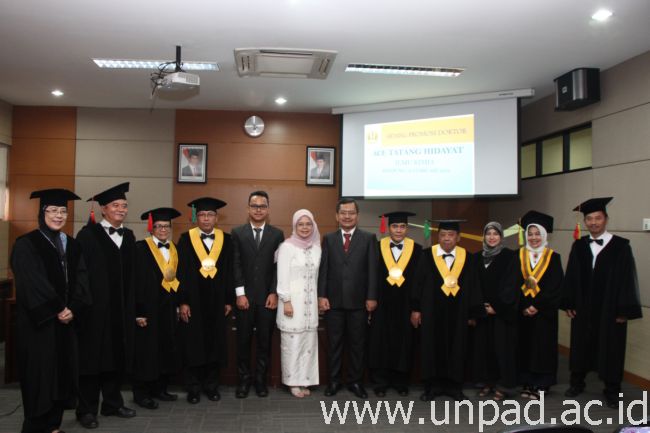
The Doctoral Promotion was headed by Prof. Dr. Sudrajat, M.S., and Session Secretary Dr. Euis Julaeha, M.Si., with Promotor Team of Prof. Dr. Huesin H. Bahti, Prof. Dr. Ajeng Diantini, M.Si., Apt., and Dr. Achmad Zainuddin, M.S., Expert Opponent Team of Prof. Dr. Unang Supratman, M.S., Dr. Pharm. Joshita Djadjadisastra, M.S., PhD., and Dr. Dadan Sumiarsa, M.S., also representative of Professor by Prof. Dr. Ukun MS Soerdjanatmadja, M.S.
In the promotion session, Ace officially received a Doctorate with Very Satisfying Grade.*
Reported by Arief Maulana / eh