[Unpad.ac.id, 22/04/2016] Welcoming the formation One Asia Communication, education is an important supporting sector for realization. The concept of good and accessible education can change the face of Indonesia and Asia.

Rector Universitas Pendidikan Indonesia, Prof. Furqon, PhD., said that appropriate education to unite all countries in Asia is the education that emphasizes peace. Peace education will produce a peaceful man and create a man who loves peace.
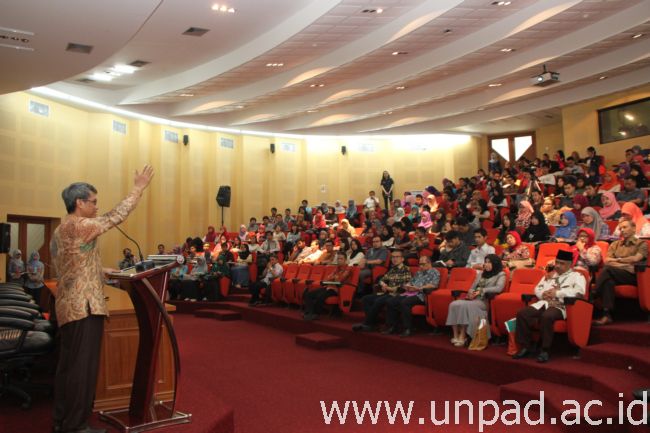
“People of the new Asia will be created if a society that loves peace consisting of a peacefull community exists. This peaceful community development is through education, “said Prof. Furqon during public lecture “One Asia Lectures” at Bale Sawala Rector Building Campus Jatinangor Building, Friday (4/22).
To be able to produce concept of peace education, curriculum must be able to prepare a variety of competencies needed by Asian societies today. According to Prof. Furqon, the current educational curriculum should include critical thinking and problem solving, communication and collaboration skills, as well as information and communication literacy.
“This curriculum should be common standards, adapted to the characteristics of the countries in Asia, approved, and became an important part of the curriculum at the corresponding countries,” said the former Head of Research and Development for Ministry of Education and Culture of 2014 – 2015.
Thus, level of competence in all Asian countries would be similar and diverse so that within process of exchange of resources, Indonesia is not only sending hard labor to the countries in Asia, but also capable of sending competent and compatible human resources.
“One Asia Society must be strong, based on a mobility balance of one country and another, “said Prof. Furqon.
How about education system in other countries? In Japan, for example, an international education becomes a model that has been applied by the Japanese Government. Since the 1990s, the Japanese government has been seriously establishing concept of international education, with early implementation in the primary level.
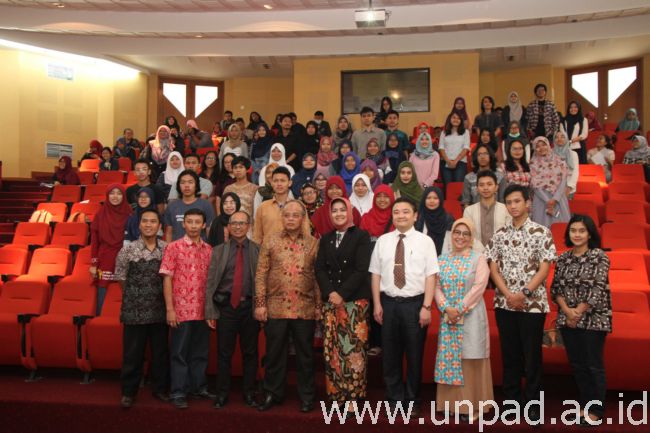 National Chi Nan University Taiwan Lecturer, Prof. David Wu Hsun Yang, PhD, said that Japan is very focused on international education. At the level of higher education, many of its education is international. In addition, almost all universities in Japan routinely conduct international research collaboration.
Meanwhile at the level of elementary and secondary education, Japan Government has implemented multicultural curriculum. One goal of this curriculum is to prepare students to join and participate in the international community.
Prof. David said there were three categories included in multicultural curriculum, namely: knowledge and comprehension (understanding cultural diversity, interdependence among countries, and importance of peace and security), skills (training intellect, intuitive, expression, communication skills, and problem solving), and attitude (practicing respect and respect, tolerance, cooperation, and participation in the community).
The curriculum is also adjusted for age and education level. Prof. David pointed out that for primary school level, the curriculum is taught by direct practice of all forms of foreign culture in Japan. At the secondary level, the material being taught will be increasingly complex.
At a basic level, international education provides an opportunity for foreign students to study in Japan. Japanese students can get a scholarship to study abroad through this system.*
Reported by Arief Maulana / eh