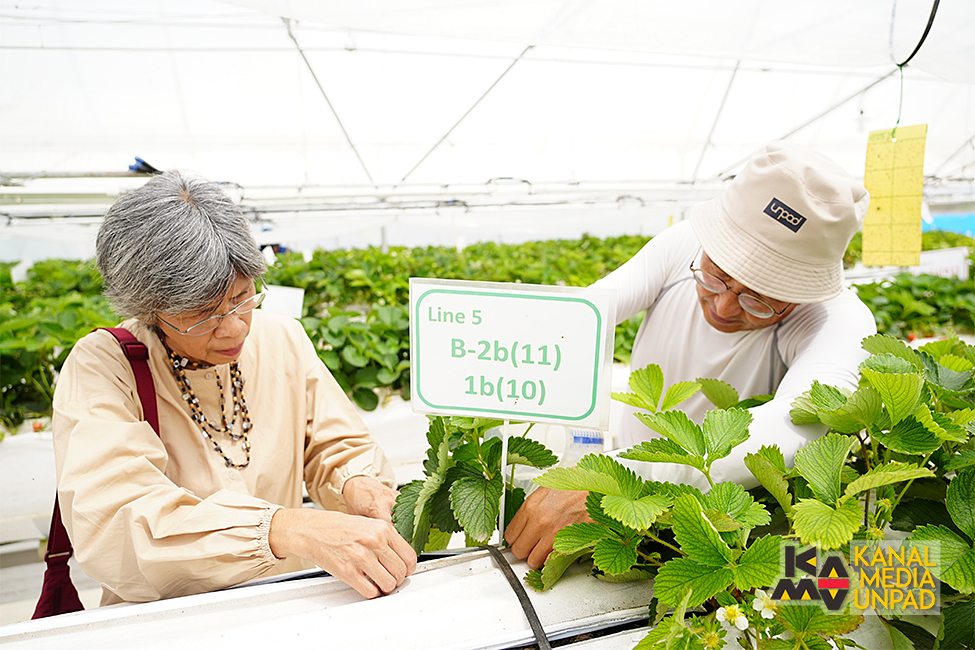
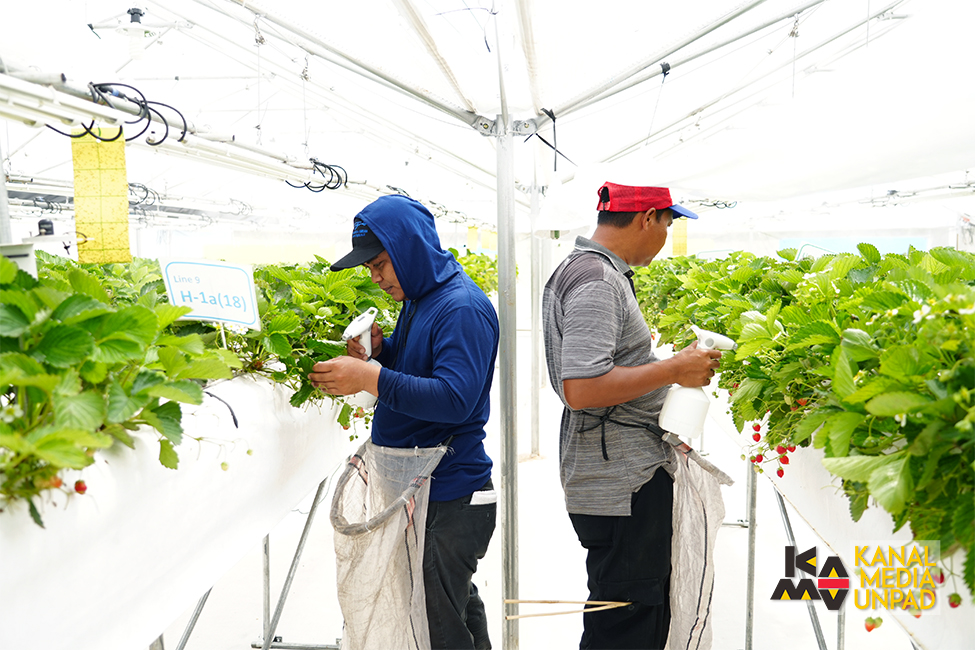
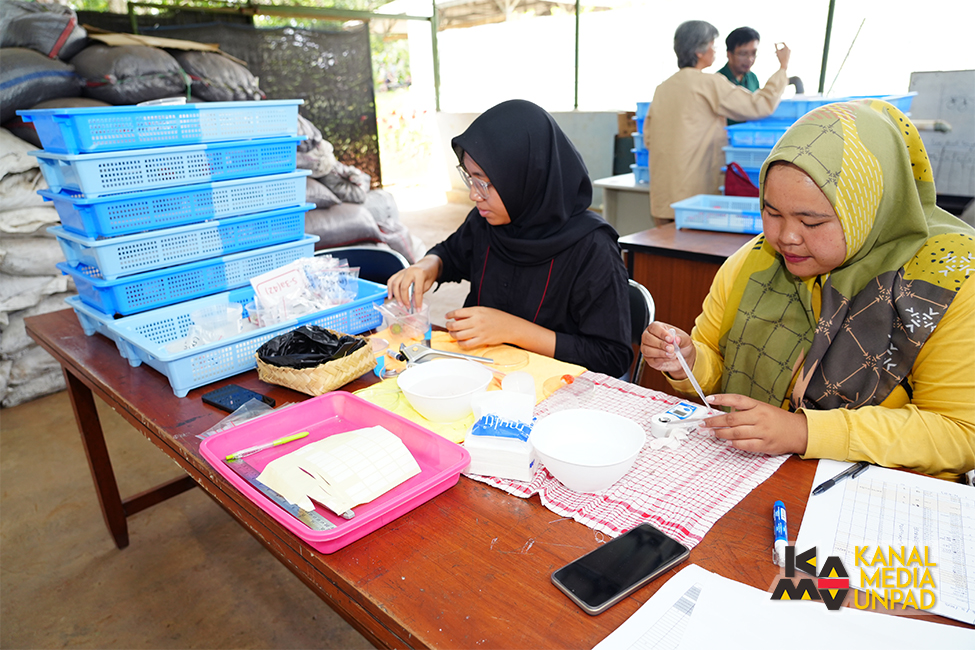
[Unpad Media Channel] The cultivation of premium Japanese strawberries in Universitas Padjadjaran has entered harvesting season. Five varieties of strawberries originating from Japan was successfully cultivated in Unpad’s greenhouse in Jatinangor. Indonesia goes through monsoons which differentiates it from the Japanese climate.
The organizing coordinator of Ichigo Plant Factory in Unpad, Prof. Dr. Ir. Reginawanti Hindersah, M.P., said that the strawberry seeds and seedlings arrived directly from the producer in Japan. In Unpad, the seedlings are tended to using standardized procedures in the nursery until they are transplanted into a fully automated greenhouse.
The process of cultivation was done in a specialized greenhouse which was built by Unpad and improved through a collaboration with the start-up Japan Premium Vegetable (JPV) and Japan International Research Centre for Agricultural Sciences (JIRCAS). The greenhouse was also updated with specialized tools and technology so that the desired strawberries can grow in the monsoon climate.
The production of strawberries in the greenhouse uses IoT-based high-end technology as standardized by JPV. However, the hydroponic cultivation of the strawberries and seedlings uses growth mediums and nutrient solutions developed by, and based on the research of, Unpad Faculty of Agriculture (Faperta) researchers.
“This is according to the will of the board; not all of the production process uses technology from abroad; the growth medium is ours, the nutrition solution is also ours,” said Prof. Regina.
With a little modification, the growth medium and plant nutrition from Unpad Faperta turned out to suit the cultivation of the strawberries and seedlings from Japan. Unpad researchers will continue to learn from Japanese technology in order to be able to cultivate strawberries from Japan, which are known to be sweet and fragrant, in a region with monsoons.
This long process shows that we are able to collaborate. If Japan were to come to Unpad and we had no competence, maybe this collaboration would not have happened,” she continued.
Prof Regina added that the greenhouse in Unpad’s Komplek Bale Tatanen is routinely visited by the board of the company which supplies tools from Japan to ensure all of the greenhouse technology runs smoothly.
“Even until now, there is no Unpad technician who specializes in greenhouse IoT and electrical grids; certain problems are still handled by experts from Japan coordinated by JPV’s CEO, Mr. Kenji Endo,” she added.
Big challenges faced throughout the cultivation process include electrical stability and the quality of water. A blackout can cut off the flow of water, nutrition, and the IoT system in the greenhouse. This was then prevented by the provision a generator set by Unpad. Prof. Regina admits that the quality of water in the Unpad campus is not as good as it is in Japan, so water filtration and quality monitoring are carried out.
“We analyze the quality of the water every two weeks. Currently, Unpad and JPV believe the quality of water to be adequate because the taste of the strawberry is good,” explained Prof. Regina.
Gaining Market Attention
The variety of the strawberries cultivated in Unpad is that of premium. A number of directors and businesses are interested in buying the strawberries. “They come here to see and taste the strawberries because they are interested in buying premium strawberries,” said Prof. Regina. The greenhouse produces 10 tons of strawberries per 1,000 m2 which can hopefully fulfill this business opportunity.
However, Prof. Regina also pushes for local businesses to take on this opportunity to market premium strawberries. She added that although the price is rather expensive for the upper middle class market, the market for strawberries in Indonesia is still promising.
The Collaboration Continues
The collaboration in developing premium strawberries between Unpad, JPV, and JIRCAS will conclude in April 2024. So far, the research in this collaboration has succeeded in cultivating strawberries from Japan. However, the final results of the research will be reported in April 2024.
Not just until 2024, Prof. Regina said that the research into premium strawberries will continue. JPV has offered to carry on the collaboration after 2024. The Unpad strawberry program will work together with a large strawberry company in Japan, Kinouchi Farm, through the collaboration between the Indonesia Ministry of Agriculture and Japan International Cooperation Agency (JICA).
The collaboration will be focused in the Garut Regency to develop strawberry cultivation through plant tissue culture both in open spaces and a conventional greenhouse. In the beginning, they will cultivate strawberries with seedlings from Japan. Afterward, however, the cultivation will use Indonesian seedlings.* (ICP)