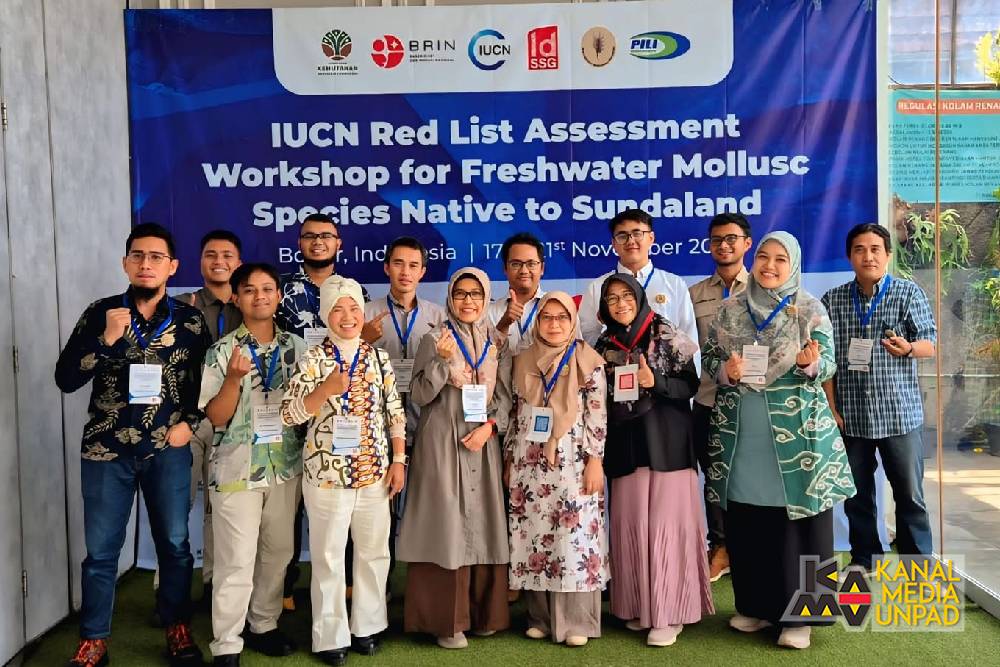
[Unpad Media Channel] Asep Sahidin, Ph.D., a lecturer at the Faculty of Fisheries and Marine Sciences (FPIK), Universitas Padjadjaran and an expert in freshwater mollusc conservation, has been appointed as an official assessor for the International Union for Conservation of Nature (IUCN) Red List in the Sundaland region. This appointment reinforces Unpad’s commitment and vital contribution to achieving SDG 15 “Life on Land” through its efforts in biodiversity assessment and conservation, particularly in Sundaland, which includes western Indonesia (Sumatra, Java, Kalimantan), Malaysia, Singapore, and Brunei. In addition to species native to Sundaland, the assessors also evaluated several urgent and threatened species from Sulawesi and Papua.
Head of the Fisheries Department of FPIK Unpad, Prof. Zahidah, expressed her pride in the international recognition received by Asep Sahidin, Ph.D. She emphasized that this achievement not only brings pride to FPIK and Unpad but also serves as tangible proof that the expertise of Unpad’s academics is acknowledged at the global level, reflecting the university’s commitment to supporting the conservation of Indonesia’s biodiversity as a valuable global asset.
The assessment was carried out during an international conservation workshop held at Royal Hotel Bogor from 17th to 21st November 2025. The workshop brought together experts in freshwater molluscs to align local scientific knowledge with global conservation standards. The activity aimed to classify the threat status of Indonesia’s freshwater molluscs based on the IUCN Red List criteria, which form the basis of national and global conservation policymaking.
Throughout the five-day workshop, the assessment team conducted an in-depth evaluation of scientific data, population dynamics, species distribution, reproductive patterns, and the threats faced by native freshwater molluscs in Sundaland, which are increasingly threatened by habitat destruction, pollution, harvesting, and the introduction of invasive species. The assessment successfully evaluated the conservation status of 192 native freshwater mollusc species from the region. The results show that 19 species are categorized as Critically Endangered, 28 species as Endangered, 17 species as Vulnerable, 21 species as Near Threatened, 68 species as Least Concern, and 41 species as Data Deficient, reflecting the urgency and complexity of conservation needs in the field.
This accomplishment reflects intensive collaboration between national and international experts, reinforcing Unpad’s role as a key contributor to the preservation of freshwater biodiversity in Indonesia and at the global level. In addition to Asep Sahidin, Ph.D., the workshop was also attended by M. Athian Ben, a Fisheries student from Unpad, as well as experts from the National Research and Innovation Agency (BRIN), Museum Zoologicum Bogoriense (MZB), Universitas Diponegoro (UNDIP), Universitas Jenderal Soedirman (Unsoed), Universitas Papua (Unipa), Universitas Tirtayasa (Untirta), IPB University, Universitas Negeri Surabaya, NGO PILI, Indonesian Species Specialist Group (Id SSG), Masyarakat Moluska Indonesia (MMI), and the Directorate of Species and Genetic Conservation, Ministry of Environment and Forestry. The presence of international specialists from the University of Nottingham (United Kingdom), University of Porto (Portugal), Museum für Naturkunde Berlin (Germany), Universiti Malaysia Sabah (Malaysia), and the IUCN facilitation team (United Kingdom) further strengthened the validity of the assessment results.
According to Asep Sahidin, the high number of species categorized as Data Deficient, reaching 41 species, indicates that many freshwater molluscs in Sundaland still lack adequate scientific information, making it difficult to determine their extinction risk with certainty. He stated that this condition poses a significant challenge for future research and requires continuous exploration and collaboration among local and international scientists to better understand the presence of these species in Indonesian aquatic environments.
The results of the assessment are scheduled to be published on the official website of the IUCN Red List of Threatened Species in 2026. The publication will provide a crucial scientific database that can support the adoption of protection measures as formal conservation guidelines in Indonesia and the broader Sundaland region.*