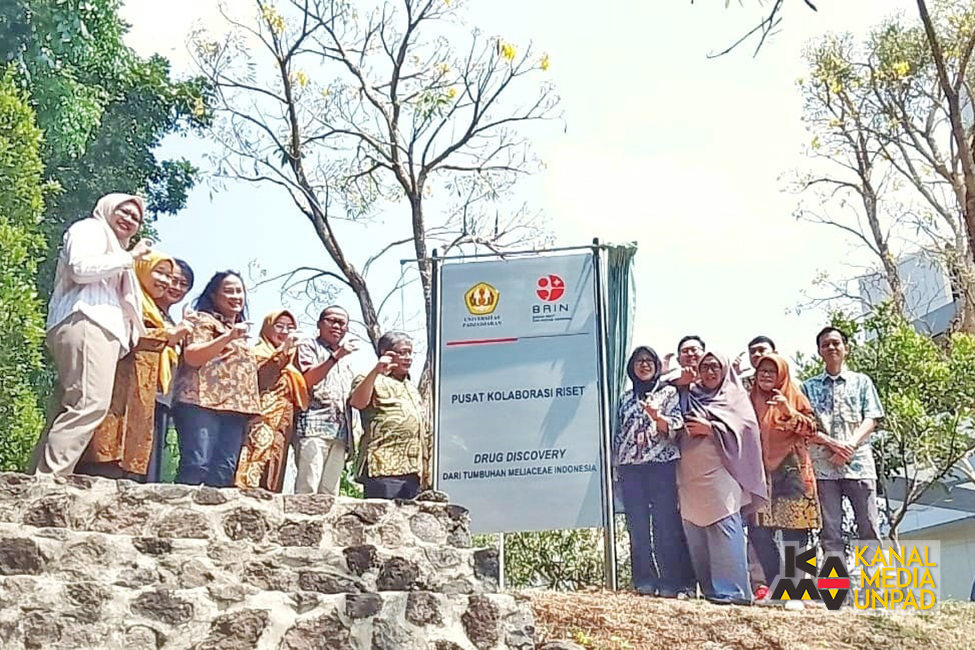
[Unpad Media Channel] Universitas Padjadjaran along with the National Research and Innovation Agency strengthens research to seek drug candidates from the tropical plant Meliaceae. This strengthening of research was done through the founding, at Unpad, of the Research Collaboration Center (PKR) for Drug Discovery from The Meliaceae Plant.
The opening of the PKR was done at the Unpad Central Laboratory Building in Jatinangor, on Thursday (2/11/2023) by the Vice Rector for Research and Innovation, Prof. Dr. Hendarmawan, M.Sc. On that event, others also attended including the Director of Research and Community Service, Prof. Rizky Abdullah, Ph.D, the Head of the Central Laboratory and Head of PKR, Prof. Dr. Unang Supratman, M.Si., and a number of Unpad and BRIN researchers.
When interviewed by Unpad Media Channel, Prof. Unang explained that the Meliaceae plant is one example of Indonesia’s natural weatlh. A few results have revealed that the plant has a number of compounds which can act as an antivirus, antimalarial, antitumor, antidiabetic, and anti-cancer . Moreover, as a tropical plant, the chemical content of the Meliaceae plant will continue to develop.
“Different from subtropical climates, where the biosynthesis processes on a plant will not continue all year, this process continues to happen in tropical climates until (the chemical contents) keep on developing and evolving into a more unique and interesting structure. This is intriguing,” said Prof. Unang.
Prof. Unang himself has researched the Meliaceae plant for more than 20 years. The research done is mostly an exploration of the plant’s chemical contents and this research has resulted in many publications. However, efforts to downstream the research is still not very prevalent.
Some time ago, the research succeeded in being awarded a grant from BRIN, this let the research to focus on the exploration of compounds as drug candidates.
Moreover, BRIN is also interested in the research of this unique Indonesian plant. “Finally we can collaborate on this research through the PKR so that the resulting compounds can continue to be utilized,” he added.
Through the PKR, seven main Unpad researchers from various faculties have joined alongside the BRIN researchers and botanists from Bogor Botanical Garden. This cooperation is carried out so the liquefaction of candidate compounds can be discovered faster.
Prof. Unang explained further that there are a few main things focused on during the activities done by Unpad’s PKR Drug Discovery. In the beginning, the team mapped out Meliaceae plants that exist in Indonesia. A few of which that were mapped out being petai cina , duku, kokosan, and langsat. It is hoped that this mapping out process will uncover a new species.
The next step is exploring the chemical and biological content. The team is optimistic they will uncover a new potential compound for health science.
“This is our wealth so we have to explore it, don’t let it go to waste. If we only use the lumber, as time goes on the plant will go extinct,” said Prof. Unang.
Prof. Unang explained that around 65 percent of the plant’s spread is in Indonesia. This is why the chance to research the Meliaceae plant by Indonesian researchers is sizable. The resulting research also has a chance to be cited by other researchers to the point where Indonesia becomes the center of research for the Meliaceae plant.* (ICP)