[unpad.ac.id] For the Unpad Faculty of Animal Husbandry professor, Dr. Ir. Mansyur, M.Si., IPM, grass is an economic commodity that can be developed to become high-quality animal feed. This motivated him to become one of only a few experts on animal feed plant breeding dabbling in the breeding of plants for feeding animals in Indonesia.
This expert in animal feed plants focused on developing grass as a potential animal feed. This is influenced by Indonesia, being a tropical country, having vast levels of biodiversity. Unfortunately, biodiversity in Indonesia has never been explored enough to fulfill needs for forage to feed livestock.
“Meanwhile, our cow and livestock feed is mostly made up of forage. If we can optimize the role of forage, farmers will prosper, and animal husbandry will develop,” said Mansyur.
To make it quality forage, technological engineering is needed. This was done by Mansyur when he was asked to supervise the forage for feeding horses in a plot of land owned by Bio Farma. Since 2019, the technological engineering of forage feed done by Mansyur has increased the productivity of horses as the main ingredient in making serums.
“Once, 10 hectares was not enough to feed the horses, after a year, currently, around 4 hectares is enough. There is a problem in the productivity of forage in fulfilling the need for feed,” he explained.
In the beginning, Mansyur selected the right types of forage to give to the horses. There were a few collections of forage served. From the various collections, the type of forage that produces high productivity and quality was chosen.
The selection process resulted in two varieties being considered adequate, napier grass and kikuyu. Mansyur explained that the second variety, kikuyu, is often considered to be imported grass from Nigeria. After further research, however, Indonesia was found to have varieties of kikuyu, mainly in West Java.
The local kikuyu was then researched. The results of which showed local kikuyu to have high levels of protein (18-22%) and a digestibility rate of 65%. This makes kikuyu the highest quality type of grass in Indonesia.
Considered Crazy
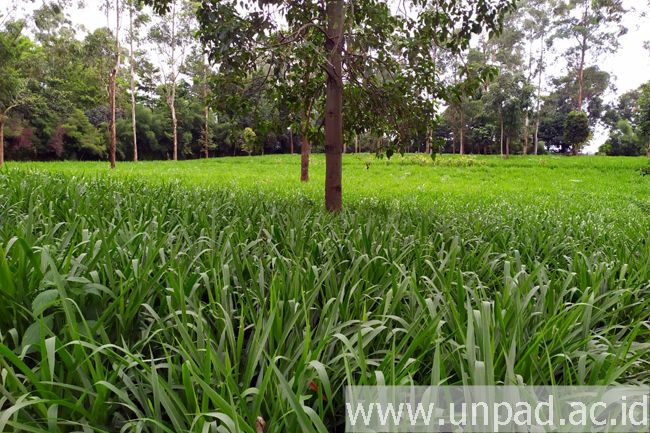
The local kikuyu and napier grass were then planted in Bio Farma’s grass field. Mansyur then changed management of grass planting entirely.
Although the grass is usually planted just as is, there were four grass development introductions done under Mansyur. The four introductions were, changing the method of planting grass, changing soil fertility, using organic fertilizer and chalk, and vegetation design.
The planting pattern was also thoroughly regulated. One plot of land was grouped into several blocks.
“People call me crazy because I plant grass like how one would plant potatoes. I use tractors, and I add organic fertilizers and chalk to the soil,” joked Mansyur.
As it turned out, his methods yielded good results. One plot of 100 m2 was able to yield 1,5 tons of grass with each harvest. With that, the 4 hectares of grass was enough to feed the horses everyday.
Mansyur explained that, aside from the quality forage, the key to success lies in the fertilizer. “I make an effort to utilize livestock waste as organic fertilizer. The keys are the fertilizer, soil management, and chalk,” said Mansyur.
This method has the potential to be applied in other plots of land used in animal husbandry, considering the ever-narrowing amount land for grazing in West Java. Because of that, with the help of technological innovation, it is hoped that this method can continue to produce quality forage that is able to fulfill the need for quality animal feed.
Mansyur continued to carry out research on the prevalence of the mix of forage for horses. The result, the mix of 75% napier grass and 25% local kikuyu grass is favored by the horses.
Interestingly, this forage is also able to increase the horses’ performance. The horses’ weight has increased and their immunity has also improved after being fed quality forage.
“As long as the antibody titer results remain high, the serum production harvest can be done for longer periods of time,” said Mansyur. (arm/ICP)*