[Unpad.ac.id, 1/09/2013] Inefficiency in bureaucracy is one major obstacle for business climate to grow in Indonesia. Following are corruption, and infrastructure. However, hope is still there. Various improvements are evident.

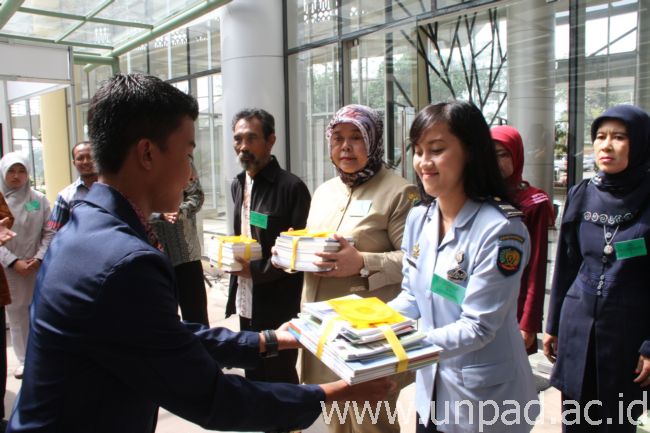
The minister for national development planning and the head of the national development planning agency (Bappenas), Prof. Dr. Armida S. Alisjahbana, SE., MA. , when speaking before faculty of business and economics students and lecturers in the reception ceremony in Dipati Ukur, argues that “time, procedures, costs have now been reduced, which businessmen and investors can take advantage of. Furthermore, the government also help improve investment climate by making permits easier to obtain, and organizing one-door integrated services,” said Alisjahbana, who is also FEB Unpad professor.
In 2013, the government builds 468 one-door integrated service outlet, in 33 provinces, 339 regencies, 93 cities, and 3 free trade regions and free ports. In addition, simplified procedures for investment had been established within the year of 2012-2013 through the implementation of the Electronic Information services system and investment licensing in 60 regencies/cities in collaboration with the Indonesian Investment Coordinating Board (BKPM).
Human Resources Development
On the same occasion, Alisjahbana emphasizes the increasing demands for higher education Globalization is pivoted on two main powers, namely trade and technology, resulted from research pieces cleverly transformed intro innovation product.
“Economic development has shifted and now focuses on knowledge based economy. Education is, therefore, strongly attached to our national economic resurrection. Education can create skilled and intelligent human resources who will generate technology-driven economy for the nation,” she added.
The betterment of human resource development can lead to the betterment of competitiveness of Indonesian human resources. According to the data released by the Ministry of Education and Culture in 2010, 51,5% Indonesian workers have only undergone primary education, 18.9% secondary education, 22.4% high school, and only 2.7% non-degree program, and 4.7% higher education (university graduates).
It is expected that in 2030, the proportion would change drastically, at least 25% of them hold diploma degree and 20% hold undergraduate degree. Those who will have graduated from primary schools will only reach not more than 10%.