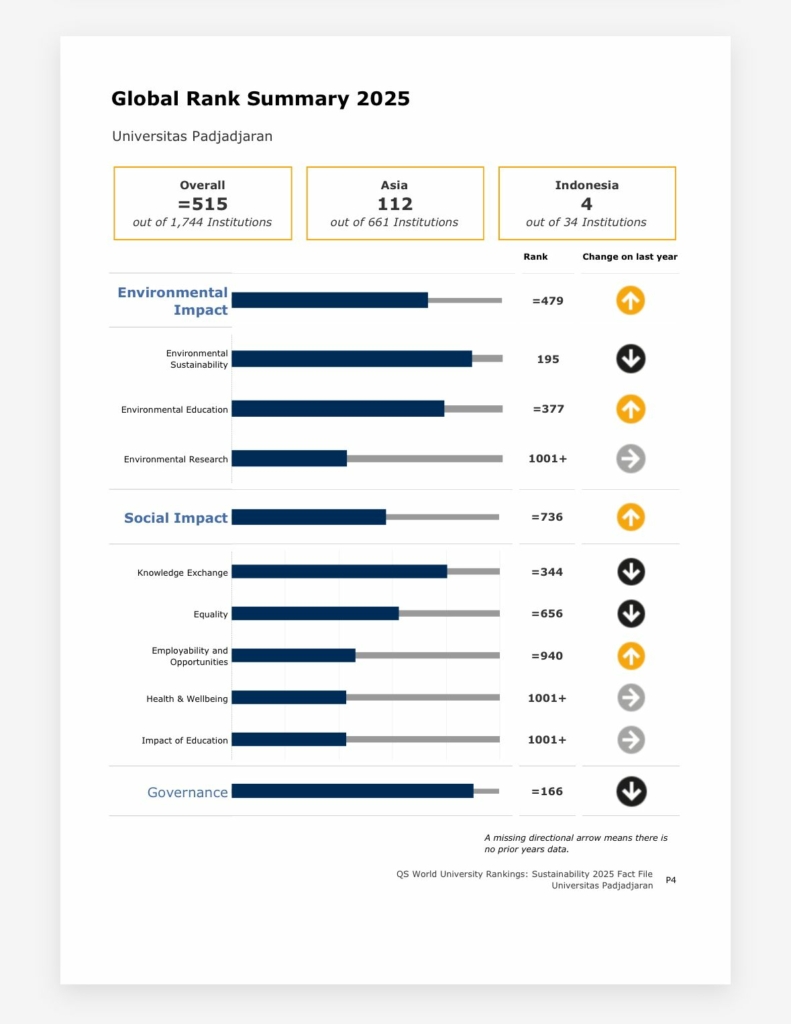
[Unpad Media Channel] Universitas Padjadjaran (Unpad) has achieved 4th place nationally in the QS World University Rankings: Sustainability 2025. The rankings, released on Tuesday, December 10th, 2024, evaluate institutions based on their commitment to sustainable development, including environmental impact, social impact, and governance. Last year, Unpad ranked 5th nationally in this category.
“Although these rankings are not our primary goal, they serve as an acknowledgment that Unpad’s quality and performance are increasingly recognized internationally. We owe this achievement to Unpad’s previous leaders, especially former rector Prof. Rina Indiastuti,” said Rector Prof. Arief S. Kartasasmita during an interview with Unpad Media Channel in his office on Wednesday, December 11th, 2024.
The rector emphasized that this international recognition is both a blessing and a motivator to continue current efforts. “It also reflects that collaborative work leads to results aligning with our expectations,” he added.
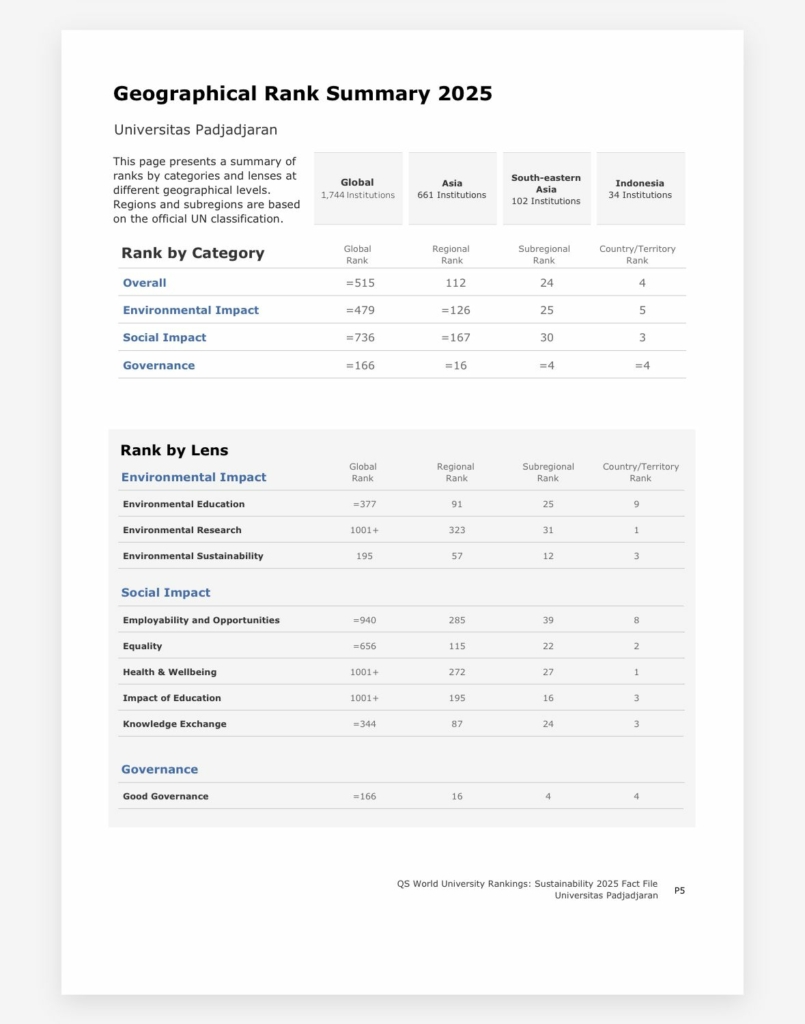
Unpad excelled in two key areas, achieving the top national ranking in environmental research (part of the environmental impact assessment) and health and wellbeing (part of the social impact assessment). Unpad ranked 4th out of 34 institutions nationally, 112th out of 661 institutions in Asia, and 515th out of 1,744 institutions globally in the QS World University Rankings: Sustainability 2025.
Furthermore, Professor Setiawan, a professor at the Faculty of Medicine and the initiator of the Unpad Wellness Program, highlighted that the evaluation related to environmental research is linked to Unpad’s multidisciplinary and transdisciplinary environmental research activities. Unpad provides various research facilities and studies addressing environmental issues from diverse scientific perspectives.
“We have the Center of Excellence for Environment and Sustainability Science, as well as internationally accredited Master’s and Doctoral Programs in Environmental Science, and a Master’s Program in Sustainability Science. Additionally, Unpad’s Scientific Core Pattern, which emphasizes environmental aspects, has inspired research across various departments,” explained Prof. Setiawan.
Regarding Unpad’s position in the health & wellbeing category, Prof. Setiawan noted the impact of the Unpad Wellness Program, which aligns with the Health Promoting University and the Healthy Campus Program. Institutional evaluation also considers the completeness of health service facilities, both primary (Unpad Clinic) and advanced (Unpad Hospital). Additionally, Unpad provides facilities and organizes sports events to promote an active movement culture, such as bike facilities, including electric bikes.
“There is universal health coverage for every Unpad resident, with additional partnership coverage with Mandiri InHealth currently, and previously with Telkomedika. This collaboration creates equal opportunities for all Unpad residents to access healthcare services,” explained Prof. Setiawan.
Prof. Setiawan also observed a statistical improvement in employee welfare, alongside an improving remuneration system. Unpad provides various services, such as the Psychology Innovation Center (now PT Pijar Integra Psikologi Unpad), a childcare center, and healthy canteens that have been actively promoted in every canteen area across faculties for the past two years. All of these contribute to maintaining sustainable health practices within Unpad. (SA)*