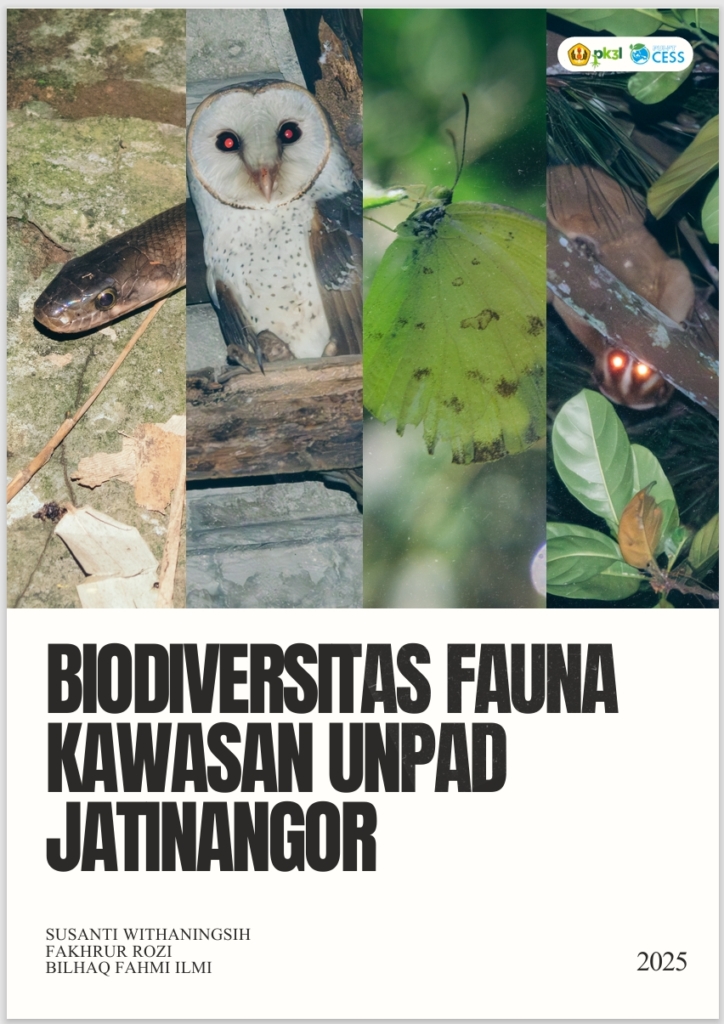
[Kanal Media Unpad] A lecturer from the Faculty of Mathematics and Natural Sciences (FMIPA) of Universitas Padjadjaran has compiled a book titled “Biodiversity of Fauna in Unpad Jatinangor Area”, which documents 115 species of fauna inhabiting the northern part of Unpad Jatinangor Campus. The soon-to-be-published book marks a strategic step by Unpad to reinforce its commitment to the Green Campus principles and support the achievement of Sustainable Development Goal (SDG) 15: Life on Land.
The book was written by Dr. Susanti Withaningsih, M.Si., along with researchers Fakhrur Rozi and Bilhaq Fahmi Ilmi from the Center for Environment and Sustainability Science (CESS) Unpad, as an effort to explore and document the rich faunal diversity within the campus area. The project involved collaboration among lecturers, students, researchers, and alumni from the Department of Biology, FMIPA, the Biology Student Association (Himbio), and CESS Unpad. The publication is supported by Unpad’s Center for Safety, Security, and Environmental Order (K3L) and the Graduate School.
“For years, field observations have shown that Unpad possesses a remarkably rich fauna diversity, yet this information has never been comprehensively documented,” said Dr. Susanti in an interview with Kanal Media Unpad on Tuesday, October 21st, 2025.
The book covers a wide range of species found in the northern part of the Jatinangor campus, including 10 mammals, 33 birds, 26 herpetofauna, and 46 insects. Among these are several rare and protected species, such as the Javan Slow Loris (Nycticebus javanicus), classified as Critically Endangered, and the Crested Serpent Eagle (Spilornis cheela), listed under CITES Appendix II, meaning it cannot be traded.
“Despite being located in a developing educational area, the campus still has extensive green zones. The mix of natural and artificial vegetation creates a habitat mosaic that supports the existence of diverse species,” explained Dr. Susanti.
The book’s preparation involved lecturers, students, alumni, and local conservation partners conducting day and night field observations using standard ecological methods such as point count for birds, visual encounter surveys for reptiles and amphibians, and insect net sweeping for insects. The collected data were verified through scientific literature and international biodiversity databases such as the IUCN Red List, CITES, and the Regulation of the Minister of Environment and Forestry No. P.106/MENLHK/Setjen/KUM.1/12/2018.
Dr. Susanti noted that the main challenges during fieldwork were limited observation time, especially for detecting nocturnal species like the Javan Slow Loris, and the need for high precision in species identification due to morphological similarities requiring expert taxonomic verification.
“In the future, I hope for greater attention toward campus fauna conservation. I also plan to collaborate with NGOs to install tracking devices so that the movement and range of the slow loris can be continuously monitored, ensuring its sustained presence on campus,” she said.
According to Dr. Susanti, the main message of this publication is to encourage the academic community and the public to begin biodiversity conservation efforts from their immediate surroundings. The book aims to foster collective awareness to appreciate, protect, and preserve campus fauna, as environmental sustainability depends on maintaining ecological balance.
“We don’t have to go to national parks to witness the beauty and importance of wildlife—the campus where we study already holds extraordinary life,” she added.
The book “Biodiversity of Fauna in Unpad Jatinangor Area” has undergone revisions based on feedback from editors Prof. Dr. Erri N. Megantara and Prof. Johan Iskandar, M.Sc., Ph.D., and is currently being processed for an ISBN before its publication by Unpad Press. It will be made publicly accessible for free through the official K3L Unpad website, allowing anyone to learn about biodiversity within the campus environment. (Release by: CESS Unpad)*