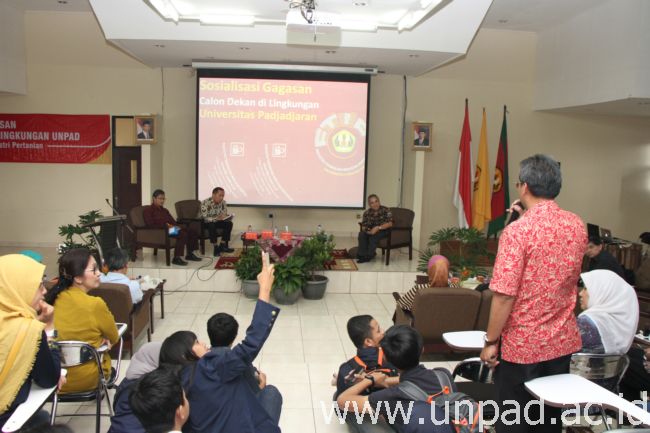
[Unpad.ac.id, 22/09/2016] Medical schools must be prepared to face the challenges of globalization and the massive advances in digital technology. This preparation is also looking forward to the demographic bonus era which is predicted to peak in Indonesia in 2035.
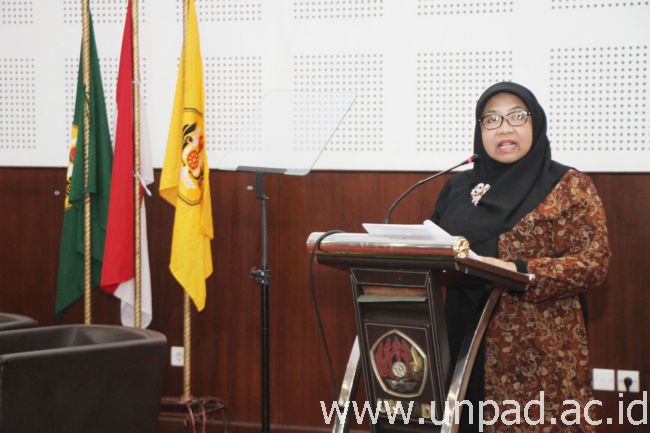
“We must prepare the graduates to be capable of using the technology. As researchers, we must begin to spawn the idea of a new health care model that is more accessible and affordable assisted with digital information technology,” said Dean of the Faculty of Medicine, Dr. Yoni Fuadah Syukriani, dr., MSi., SPF., DFM, when delivering a speech at the 59th anniversary of the faculty at the Auditorium of Unpad Teaching Hospital, Jln. Eijkman, No. 38, Bandung, Thursday (22/09).
The event was also attended by the Rector, Prof. Tri Hanggono Achmad, university officials, and faculty members, as well as representatives of hospitals in Bandung, leaders, professors, Faculty’s academic community. On the occasion, Dr. Yoni conveyed a scientific oration entitled “The Future of Medical Education Facing the 4th Industrial Revolution”.
The rapid development of digital technology would benefit the quality of the health sector. Dr. Yoni said, compared to other professions affected by the massive digital technology, the need for health workers remains high. What has changed is a shift in the profile of expertise.
“The stability of the type of expertise will be disrupted. There are types that become less necessary and others become more necessary. Clearly we have to be ready to respond this in an integrated and comprehensive method, “said Dr. Yoni.
Further, Dr. Yoni said, advances in technology changed the access to health services, which was previously performed by professionals and costly to become much more affordable and accessible to more people. This innovation is named distractive innovation. On the one hand, it can create better services enjoyed by many people, but it will disrupt the status quo of health care.
With the support of digital communication technology, some health services have been up to in the hands of individuals. Dr. Yoni said that people now can monitor the condition of their health through a variety of applications available on the device. In fact, he continued, the application is also able to assess whether the results of these measurements are accurate or not.
Dr. Yoni explained that when the exact diagnosis methods were not available yet, the treatment was given through intuitive medicine, or carried out by the professionals. When the pattern was clear, the service will directed to evidence-based medicine. When the diagnosis was certain, precision medicine was resorted.
“In the past, almost all services were in the domain of intuitive medicine, now they are shifted to the evidence-based and precision medicine,” explained Dr. Yoni.
Dr. Yoni said the shifting realm would also change the pattern of medical education that leaned toward precision medicine. Doctors will be instrumental in organizing and supervising services. “They are only needed on research on emerging new diseases or for complex cases,” he continued.
For the curriculum, Dr. Yoni argued that basic medical education should be in parallel with the clinic. It is based on the assumption by most experts that the four-year basic medical education is often inefficient.
Therefore, the application of digital information technology must always be integrated in medical education. Online courses, for example, will allow medical students to get the basic medical science.
“If we want the students to possess competency on specific disease treatment, we need to more aggressively develop educational tools, such as illness simulator, online modules on disease, patient videos, and telemedicine meetings,” said Dr. Yoni.
Faculty of Medicine, said Dr. Yoni, had already been on the “right track”. They have implemented the concept of the Student Centered Learning by learning basic science-based cases, encouragement of self directed learning, using digital information technology, supervision of distance learning, telemedicine, early clinical exposure, and interprofessional education.
“In the early stages of development, the program can be said as distractive innovation, but now we need to refine it to be more sustainable,” said Dr. Yoni.
 This corridor was also emphasized by the Rector to the Faculty. In his speech, the Rector said that the Faculty should be the locomotive for both developments of the institution and the nation. “Our plan should be based on the need of the community,” said Rector.
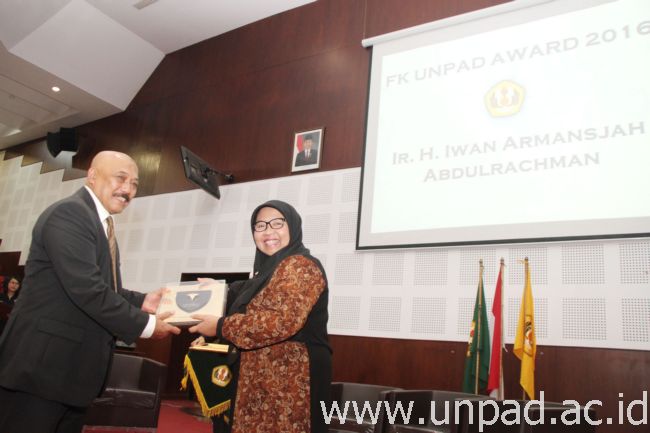
In the event, it was also awarded the Faculty Award 2016 for the composer of “Himne Unpad” who is also musician and cultural and environmental activist, Iwan Abdulrachman. The award was presented for his contribution in providing character education, leadership, and example to the students of the Faculty. The award was given directly by Dr. Yoni to Abah Iwan. *
Reported by Arief Maulana / eh