[Unpad Media Channel] Becoming a fisherman is to venture into a profession with a high risk to one’s safety. Aside from the high safety risk, the mental health of fishermen is also in a vulnerable position. There are still not many who care about the mental health of fishermen.
This motivated an Unpad professor from the Faculty of Fishery and Marine Science, Alexander M.A. Khan, S.Pi., M.Si., Ph.D, to begin the development of an Android-based mobile phone app to monitor the mental health condition of fishermen.
The app, named “TUNA”, was developed together with a number of professors and researchers from a couple of faculties, namely the Faculty of Fishery and Marine Science (FPIK) and the Faculty of Psychology (Fapsi). The app is a result of research funded by the Ministry of Education, Culture, Research, and Technology since 2021.
“We can see that mental health, especially in the fishermen community, has not been a priority as of now. Usually, the monitoring of mental health is done on youth, formal employees, pregnant mothers, or people suffering from physical conditions,” said Alex.
Alex admitted that the mental pressure experienced by fishermen is very high. Although they work as informal employees, the mental pressure of being a fisherman is similar to someone working as formal employees. Several studies have shown that fishermen are prone to illnesses caused by mental pressure.
The results show that the variables causing anxiety, stress, and depression in fishermen are logistical limitations to go seafaring (unstable fuel cost and stock), the decrease in the market value and quality of caught fish, and weather anomalies. This is especially true for fishermen who operate in areas bordering the ocean.
Aside from that, the unequal level of general welfare also puts more pressure on fishermen. The amount of income is often not proportional with the high operational and living costs.
For this project, Alex is supported by a team consisting of Prof. Dr. Zuzy Anna, M.Si. and Ajeng Wulandari, S.Kel. from FPIK Unpad, and Aulia Iskandarsyah, M.Sc., M.Psi., PhD, Psikolog and Arina Shabrina, M.Si. from Fapsi Unpad to develop the TUNA app. Their aim is for the fishermen to know their mental condition before they go seafaring.
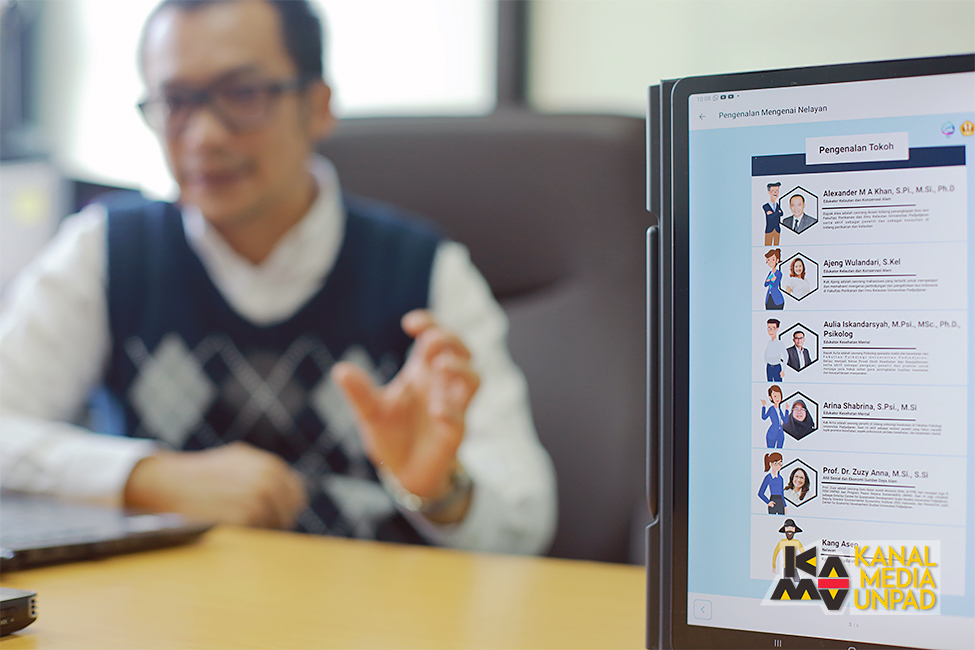
“This is so the fishermen can figure out if their mental condition is not optimal, and can then, advisably, not go to sea. Or if a fisherman needed a discussion or counselling session on the app, we can help them through the counselling or hotline services available on the app,” said Alex.
Using Questionnaires
The app contains a few questionnaires required to be filled out by the fishermen. The questionnaires adapted the Depression Anxiety Stress Scale (DASS) often used to measure levels of anxiety, stress, and depression. There is a small amount of modification to adapt it with the needs of the research.
The answers from the fishermen will determine the severity of the mental pressure that they experience. If the stress is mild, then it is advisable that they do not go out to sea until they are in optimal condition. If the results indicate moderate or severe stress, the app will advise them to go through counseling with a psychologist or health professional.
Alex said that the fishermen may choose to visit the closest counselling location as directed by the app. This channel will go through to the team from Unpad’s Faculty of Psychology.
As long as the research goes on, the team will provide free counseling for the fishermen. “Hopefully, the app can stand on its own moving forward,” he added.
Custom-Made for Fishermen
Alex explained that monitoring mental health is as important as monitoring physical health for fishermen. A healthy mental state will create a calm fish-catching experience. This is true, especially if it is aided with adequate logistical support, conducive weather, and high selling price.
This is because the fishermen are actively putting their lives on the line to catch fish. A disturbed physical or mental will increase the risks for a fisherman.
“For that, our task is to, through research, help them understand how severe their stress levels are,” said Alex.
The TUNA app is already available on the Google Play Store. Currently, the app can be used by anyone. The plan moving forward is for the app to differentiate between questionnaire data coming from fishermen and those not coming from fishermen.
It would work by entering the user’s Nomor Kartu Nelayan (Fisherman Card Number) before filling out the questionnaire. The Fisherman Card itself is a program run by the Ministry of Marine Affairs and Fishery to provide legal documentation for fishermen. With this card, the fishermen can gain access to facilities provided by the ministry.
With the data in the form of these numbers, the team can differentiate which data is filled out by fishermen and which are not. The data from a fisherman would be a part of the research done by Alex and his team.
“From this data, we could figure out the level of stress, anxiety, and depression of the fishermen in percentages. To sort out the data, we need to collaborate with the Ministry,” said Alex.
When the app was tested on a number of fishermen aorund Palabuhanratu Beach in Sukabumi, a lot of them were enthusiastic. The fishermen were becoming vigilant toward their mental health.
“So far, they haven’t paid attention to their mental well-being. Hopefully, this app can help them be aware of their own mental health,” said Alex.
Additional Features
But will an Android-based app be easy to use for fishermen? As it turns out, based on the team’s observations, most fishermen of working age already use smartphones, especially those in West Java. For the rest, some in the group of people aged 60 or older still use traditional cell phones.
“From there we can decide whether it would make sense to develop this app. Our initial aim is for it to be beneficial. If it is not, we will not be doing it,” he said.
Alex also wished for the development of the TUNA app to be directly based on the needs of the fishermen. He has also asked for feedback from several fishermen regarding what they would need from this application. It is hoped that this feedback can push TUNA to become a must-have for fishermen before they go seafaring.
“We want this app to be based on citizen science,” he added.
Several pieces of feedback considered included developing a space for inter-fisherman communication. For example, fishermen in Pangandaran can help write down the selling price of certain fish commodities. This price would then be a guideline for fishermen in Palabuhanratu for negotiating fish prices.
Aside from that, there was also feedback for them to provide information on the weather, the height of waves, the locations for catching fish, and the price of nets or other fish-catching tools. “We will sort the data,” said Alex.
The plan is for the TUNA app to work in collaboration with a relevant government institution, such as the Ministry of Marine Affairs and Fishery, Coordinating Ministry for Maritime & Investment Affairs, and the Ministry of Health, so that the app can be used by fishermen across the Indonesian coasts.
With that, Indonesian fishermen can become more vigilant about their mental health. “The results from this research will be proof that Unpad is beneficial and international,” concluded Alex. (arm/ICP)*