[Unpad Media Channel] The earth is brimming with activities unnoticed by humans. One such activity that often occurs is earthquakes caused by the dynamics of faults in the earth’s layers. Almost all parts across the globe have active faults that cause movement, Indonesia is no exception.
According to an Universitas Padjadjaran professor at the Faculty of Geological Engineering’s (FTG) Department of Geological Science, Dr. Ir. Ismawan, M.T., faults occur when there is movement from tectonic plates. As a country located between two continents and two oceans, Indonesia experiences many phenomena surrounding the movement of tectonic plates.
“Because the movements interact with one another, it causes other parts outside of the plate itself to deform,” said Ismawan.
Faults have taken shape since the earth’s forming, many are still active currently. In West Java alone there are at least three major faults whose movements have been recorded, Lembang Fault in the north of Bandung, Cimandiri Fault in Sukabumi, and Baribis Fault in Majalengka.
Ismawan explained further that one type of fault movement manifests in earthquakes. The effects of the tectonic earthquake varies. It depends on the proximity of the earthquake’s location with its epicenter.
An earthquake with a small magnitude has the potential to cause damage should the hypocenter have a shallow depth compared to its epicenter. Inversely, an earthquake with a large magnitude may not cause damage or tsunamis if the hypocenter is located far below the earth’s surface.
Although active faults need to keep moving, the movement itself is rather minimal. As an example, the tectonic movement of Lembang Fault is around 3 millimeters annually. This only causes earthquakes with small magnitudes.
The vibrations caused by those small earthquakes might not be felt directly by the people on the surface. “The small earthquakes would be recorded in the seismograph,” added Ismawan.
Ismawan also added that active faults which cause small earthquakes are considered less dangerous than ones which have never resulted in an earthquake.
Characteristics of Faults Zones
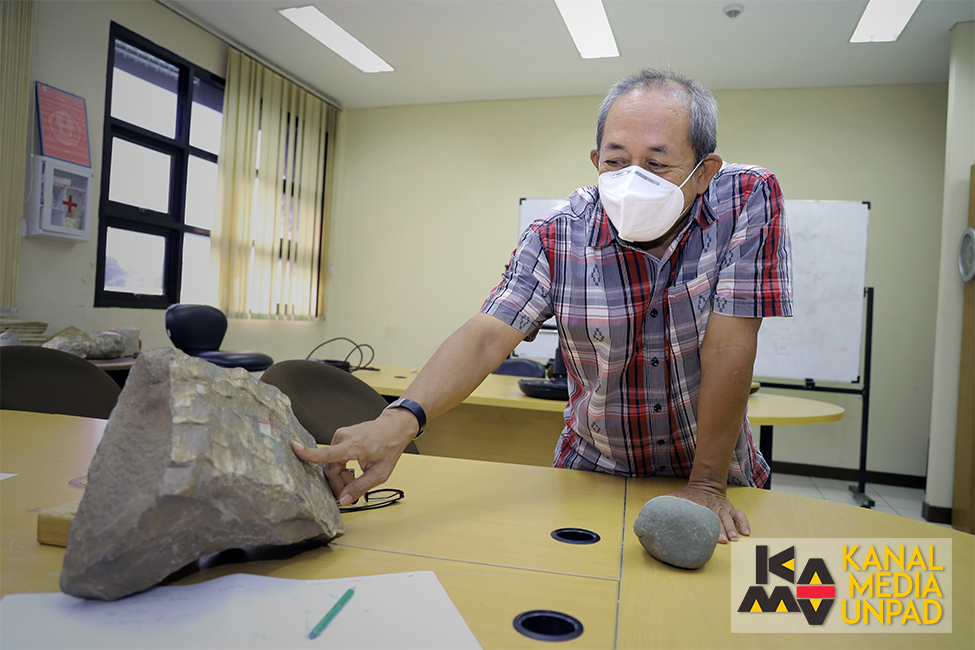
The head of the Unpad FTG Geodynamics Lab also said that a region can be interpreted as a fault zone based on its topography. One of the most simple ways is by looking at the topography through Google Earth.
“If we look at Bandung, for example, what we call the Lembang Fault can be clearly seen. There is a traceable lineament running from Padalarang and almost ending up in Manglayang Mountain,” said Ismawan.
However, topographical data is not enough to conclude that the region is an active fault zone. Further proof is needed by measuring the intensity of earthquakes in that region.
“If it is an active fault, it will be accompanied by earthquakes. The earthquakes signal that the fault is moving,” he said.
When it comes to fault zones, a few studies have indicated that Bandung does not only have the Lembang Fault. The Pusat Survey Geologi (Geological Survey Center) once recorded that there are at least a few active faults in the Bandung Raya area.
A report by Tempo once noted the existence of the few, potentially active, faults. They are the Cicalengka Fault, Jati Fault, Ujungberung-Cileunyi Fault, and Gunung Geulis Fault. Although the four faults are considered less famous, some indicators show they are still active.
“Although their manifestations have never been felt by humans, there are earthquake measuring tools there. Even from their topographical appearance, there are indicators that the faults are active in those areas,” revealed Ismawan.
Mitigation is Needed
So far, there has not been a method that can predict when an earthquake caused by tectonic plates converging will occur.
Ismawan said that tectonic earthquakes are different than volcanic eruptions, which will show natural signs. Eruptions are more easily predicted than tectonic earthquakes.
In predicting tectonic earthquakes, experts usually give a longer timespan of when it might occur. This illustrates that, although they cannot be predicted accurately, the earthquake might still happen, if at an undetermined time.
This is done since there is no accurate technology which can tell when a huge earthquake will convulse the surface above it.
“One thing is for sure” said Ismawan. He emphasized that people, especially those in active fault zones, need to have good knowledge of disaster mitigation. The role of the government, community, and organizations are needed, specifically in disseminating information on faults and the potential for disasters that surrounds it.
“The public needs to be educated adequately so that they understand the dangers of living in such areas. Safety drills simulating disasters should be taught in school,” Ismawan concluded. (arm/ICP)*