[Unpad.ac.id, 18/01/2016] Based on results of numerous studies in Indonesia, it is concluded that vast majority of agricultural land conditions in Indonesia are categorized as “indisposed”. The indisposed soil is mainly around industrial area, which is affected by waste disposal.
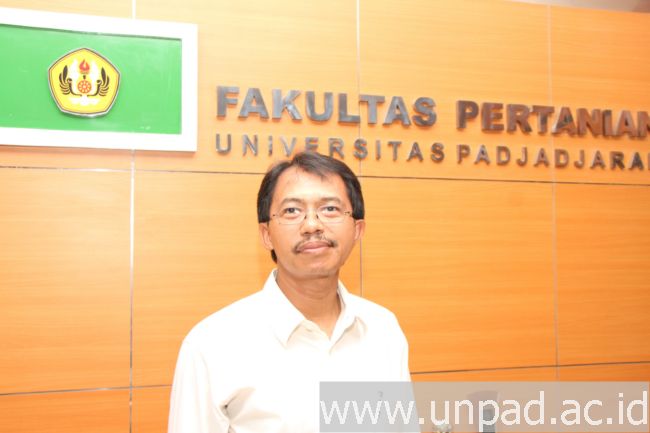
Lecturer of Faculty of Agriculture Universitas Padjadjaran, Dr. Rija Sudirja, SP., MT. said that this condition could result in failure of growing plants or partial success of when plants do grow but does not yield expected result.
“I discovered that the plants produced will contain harmful toxic substances. The results of my research stated that there are some substances or metals within the plant tissue, “said Dr. Rija at office.
Dr. Rija added that if the substances have entered the plant tissue, it could be consumed by human and be harmful to our health. For example, in rice, the dangerous substances would contaminate the grain.
“It would be very dangerous for health as well. Not only that it would harmthe environment but also the health and safety of living beings, “said Dr. Rija who studies science of Soil Fertility and Plant Nutrition.
Dr. Riza’s team has been struggling in attempts to overcome it. “After all, contaminated soil must be restored at the same time as the community to continue producing,” he said.
One of the attempts was to develop fertilizer that he referred to as “Multi-Function”. Not only providing nutrients for plants, the fertilizers also reduce levels of toxic substances in the soil.
“I have tried to examine variety of materials that could absorb toxic substances as well the materials as plant nutrients,” said the man who was born in Sumedang, August 19, 1969.
Dr. Riza said that this fertilizer has gone through laboratory and effectiveness test. He designed these fertilizers to be applied in land that was already polluted by textile industry.
Currently, it is still in development, including the attempt to enrich content of fertilizer with microorganisms. “The fertilizers will be enriched with microbes that are able to break down or degrade toxic compounds in the soil and lessen the residue,” he explained.
In addition, he also hoped Faculty of Agriculture Unpad could set a “mini factory” to establish formula and products for industrial purposes, according to each crop’s requirement.
Re “healthy” soil, Dr.Riza explained that soil ideally contained 5% of organic matter “Now, soil in Lembang, for example, has only 2-3% range. Areas of high levels of leaching because of rainfall will have higher range,” he said.
In addition, there are a number of other indicators to show the damage degree of land. Dr. Rija explained that land degradation occurred due to natural factors and human behavior.
“But in general, it is the people who are less well managed. Therefore it is how we create land in order to be sustainable, “said the Head of the Department of Soil Science and Land Resources, Faculty of Agriculture Unpad.
According to him, each management it must posses value of environmental responsibility. Therefore, he has always tried to find a solution in order to not only improve agricultural production but also keep the environment and sustainability.
Up until now, he had done various research and community service related to sustainable agriculture. One of them, the solar water pumps in the district of Kuningan, was launched in December 2015. In addition to the Kuningan project, the solar water pump is also a Dr. Rija’s community service project in Subang (launched in 2013) and Sumedang (launched in 2014).
Dr. Rija stated that his water pump is environmentally friendly and implements a sustainable system. The maintenance is also easy and durable. The area he has chosen are the areas that are farmers settlement that are frequently hit by drought.*
Reported by Artanti Hendriyana / eh