[Unpad.ac.id, 25/11/2013] The organic content of farmland in Indonesia has been declining, not to mention the old rice fields in Indonesia which tend to be the ultimate state soil (ultisols). This poor condition gives rise to a variety of problems that decline production.
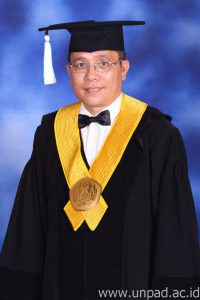
“Soil condition as such can still benefit us by using technology. We can still restore the soil fertility because actually the organic material required is already there, contained in the land itself, which is usually considered as waste material. The problem now is how to process the waste, how to turn it from cost center into benefit center, said Dr. Tualar Simarmata, Ir. MS., professor of Unpad Faculty of agriculture of soil science department.
In agricultural industry, the main products cultivated are usually much less than the waste product. Take rice production for instance. The cultivated product is one and a half times more than the waste. Unfortunately, rice straw waste has been only considered a waste product. Little do we know that rice straw waste can be processed into compost and add organic content in soils.
The soil biotechnology expert explained that straws contain of CO2 and soil nutrient elements that make it a complex compound. Straws are processed into compost and will be a great organic source. Not to mention the husk of the former waste, if processed into biocare, it will increase soil fertility.
“If the technology is applied on the land for three years in a row, the land could be fertile again between 80-90%, and we can reduce the use of inorganic fertilizer because the technology we use is Leisa (Low External Input Sustainable Agriculture). This way, we develop what is called cause reduction technology,” added Prof. Tualar.
This training has been conducted in various districts in Indonesia. In addition, he has been promoting the training in Controlled Intensification of Organic-based Aerobic Rice (IPAT-BO ) since 2006. The technology received a positive reception from farmers in various areas in Indonesia as well as the direct support from the Ministry of Research and Technology.
His inventions have brought him go around various villages in many cities and districts in Indonesia to act as a speaker in seminars and workshops. Various media have spread his the success of his invention in increasing productivity to 2 until 4 times in various regions in Indonesia.
What makes the IPAT-BO technology better than its counterparts are its power to restore damaged land, save water until 25%, save seeds until 25%, and save chemical fertilizer until 50%, as well as harvest 7-10 day faster. Therefore, this technology might be the solution to support Indonesian food sovereignty and security.
“This technology is simple and cheap because it mainly makes use of the existing or local potentials. Only the rest of the materials come from abroad. That’s why this technology received positive reception from farmers because it saves costs and improves production,” said Prof. Tualar.
In addition to community service programs through training and seminars in various regions, Prof. Tualar also continues to develop a variety of productive research, many of which has managed to get a patent. In 2011 he obtained the patent for his Bio Fertilizer Consortium (Biofertilizers). Still in the same year, his Microbial Inoculants Rice Straw Decomposer also got a patent. In 2012, Multi-Nutrient Solution and Soil-fertilizing solution, along with Soil acidity-fixing solution and Soil acidity-fixing liquid also obtained patents.
In addition to working with various industries, the professor, who is an alumnus of Justus Liebig-Germany, along with colleagues and his graduate students in the Faculty of agriculture has been developing spin-off industry in cooperation CV Bintang Asri Artauly. The company’s products are the registered inventions of Unpad researchers. Some of the products are Bio Nutrition Degra (decomposer), BIO Bio nutrition (Bio-fertilizer), NPK Fertilizer tablet (Grandhamlet), processed organic fertilizers (BIOS) and a liquid organic fertilizer (bio nutrition) as well as liquid inorganic fertilizer.
Aside from being a production and research facility, this spin-off industry has also become the place of internships program for undergraduate and graduate students supervised by Prof. Tualar. The competence of our graduates really depends on the skills that they possess. In order to improve their skills, they need a place to learn. This place is the right place to do it and it could also be a stepping stone for some students after they graduate before they find a job,” Prof.Tualar explained.
The main issue he is currently dealing with in taking a follow-up action in conducting his research is to develop a spin-off industry. He hopes that Unpad will continue to facilitate, develop and escort the existing research to become a productive research. He believes that there are many potential research to develop in Unpad.