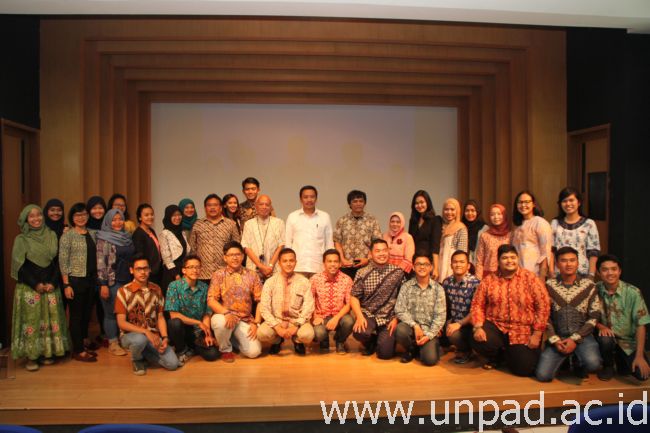
[Unpad.ac.id, 7/03/2016] The existence of Sundanese that is still part of treasures of local vocabulary in Indonesia is due to the struggle of the generation predecessor. History recorded that since the 19th century there was an attempt to reawaken Sundanese to become parallel with Malay and Javanese.
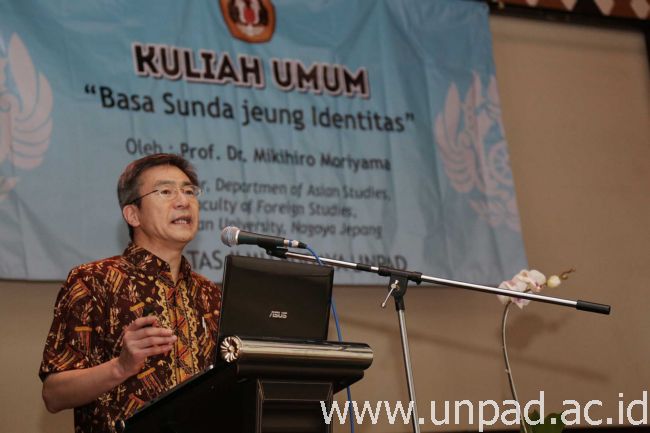
“For Sundanese people, the language is the key to identity,” said Prof. Dr. Mikihiro Moriyama, Professor of Department of Asian Studies Nanzan University, Japan, in a public lecture of Sundanese Culture at Aula of Japanese Language Study Center (PSBJ) Faculty of Arts, Universitas Padjadjaran, Jatinangor, Monday (7/03).
According to Prof. Mikihiro, Sundanese community considered the existence of linguistic important more than other ethnic groups in Indonesia. This was evident from the application of the Sundanese between Malay and Javanese by Sundanese intellectuals of the 19th century.
Citing Raden Haji Moehamad Moesa, a Sundanese writer on the 19th century, before the 19th century Sundanese was not so well known among Europeans, as well displacement of the existence by Javanese culture. This had led to efforts of improving the language existence by the writers and intellectuals.
These efforts were paralleled with the Dutch policy of not overlooking diversity of local languages in the Indies, despite having Malay as the language of communication, especially in educational environments. Prof. Mikihiro argued that The Netherlands considered the language of the natives at that time to possess a strong cultural value.
“The Netherlands has an opinion that without language, a nation would not exist. It’s a very romantic thought, “said this researcher from Japan who speaks fluent Indonesian and Sunda.
Since the 19th century, Sundanese textbooks were published due to efforts of Moesa with K.F. Holle, a agriculture businessman from the Netherlands. Since then, various Sundanese-language books, both textbooks and literature, had been widely published.
Yet during post-independence Indonesia up to President Suharto’s era, existence of local language book was undergoing difficult time, it did not affect Sundanese language books. Prof. Mikihiro argued that Sundanese tirelessly continued to produce Sundanese language books until now.
“Until now there are many published books in Sundanese, I believe there was no local language in Indonesia that is as rich as Sundanese, able to produce books since the Dutch era until today,” said the professor who studied Sundanese culture at Padjadjaran University in 1982 until 1984.
Entering the era of globalization, Prof. Mikihiro continued, fear that globalization will remove a variety of local languages, emerged. But in reality, counter flow appeared to strengthen the local language. This was seen from the emergence of various sites on the Internet that use a variety of languages, including Sundanese, in the 21st century.
He also appreciated provincial government policy to reestablish Sundanese within the scope of government. He hoped that it could also be applied to the implementation of local content Sundanese language in school.
“The application of local content Sundanese must have an independent policy, and should be planned in the long term as well,” he said.*
Reported by Arief Maulana / eh