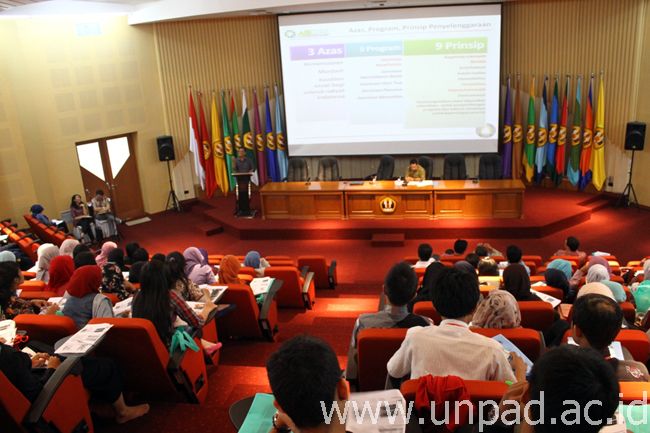
[Unpad.ac.id, 9/11/2016] Zakat, or required donation in Islamic law, is not just a command Islam. In fact, it is regulated by the government through Law No. 23/2011 on Zakat Management that clearly urges the public, especially the Muslims, or enterprises to issue appropriate obligations regarding zakat.
“As a Muslim, zakat is an obligation as a form of piety. As a citizen, it is obligatory because it is legally regulated, “said Regional Assistant III of Public Welfare Secretariat of West Java, Ahmad Hadadi when speaking at the national seminar on “Optimalisasi Zakat dalam Pemberdayaan Masyarakat” at the auditorium of the Graduate School, Faculty of Communication Science, Universitas Padjadjaran on Wednesday (9/11).
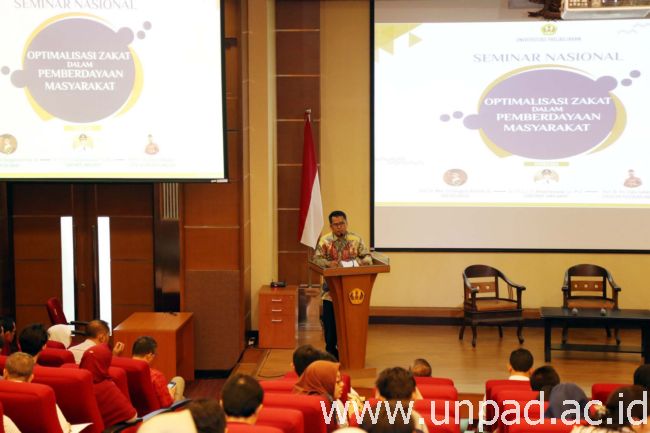
Ahmad said the wealth issued for zakat not only is beneficial to the eight type of recipient as set out in the Quran, but also may help solving various problems in society.
The West Java provincial government obligates the issue of zakat for every civil servant regulated in the Governor Regulation. Ahmad pointed out when approximately 1 million people in Bandung earn Rp. 5 million/month and issue 2.5% of their income for zakat, Rp. 125 billion/month would be collected. Such policy may be applied to municipal or district organizations, as well as educational institutions, such as Unpad. Technically, the Rectorate may implement the policy of issuing zakat for all the educators and administrative staff members through a legal-based Act. Furthermore, he also said that the fund can be used for tuition assistance for students with financial issue.
“Unpad is expected to be one example of zakat management in educational institution to be applied at other universities,” said Ahmad.
Meanwhile, Head of the National Zakat Body (Baznas) of West Java, KH. Arif Ramdani, MH, gave an example of a research in 2011 in cooperation between Baznas and Faculty of Economy and Management, Bogor Institute of Agriculture (IPB) and Islamic Development Bank (IDB) that estimated potential of zakat in Indonesia reached Rp 217 trillion annually. The government has designed five national agenda to optimize the collection and utilization of zakat.
The agenda include socialization and education of zakat, institutional strengthening, optimizing the utilization, strengthening regulation, and synergy. Arif said that the fifth item on the agenda required the role of academics, religious leaders, and community leaders.
Vice Rector of Resources and Governance Universitas Padjadjaran, Dr. Sigid Suseno, M. Hum., during the opening of the seminar said that the management of zakat had been a commitment in Unpad’s policy through the establishment and management of Zakat Collection Unit (UPZ) Unpad; such unit is the only one applied in universities in Indonesia.*
Reported by Arief Maulana / eh