[unpad.ac.id, 9/5/2019] The government is trying to realize inclusive education in every educational institution. It aims to make education not only for those who are physically capable. The disabled also have the same opportunity to be able to study in higher education.
Unpad Deputy Chancellor for Academic and Learning Dr. Arry Bainus, M.A., said that university is open to anyone, both non-disabled and disabled as long as they have good academic abilities.
“Anyone already has the opportunity to work together in university,” said Dr. Arry.
The Government of Indonesia through the Ministry of Research, Technology and Higher Education (Kemenristekdikti) has drafted a regulation that basically higher education must include all parties. This rule was agreed by Unpad and other universities.
Dr. Arry explained, people with disabilities may also enter any study program as long as it does not interfere with their field of study and work. Although there are several study programs that provide certain conditions, such as not being color blind. As long as she/he is able to attend the learning process, she/he can still join the study program.
“Moreover, the field of study that does not require anything, or as long as its limitations can be helped by technology, disabled people can participate in it,” he added.
The Ministry of Research, Technology and Higher Education has also made it easy for disabled people to enroll in higher education. The implementation of Computer Based Writing Examination (UTBK) as a requirement to apply to state university at this time can also be participated by participants who have limited vision. However, not all study programs can be registered by those concerned.
Overall, there is no difference in learning patterns between regular and special needs. “Differences are made if it cannot be followed, such as the form of the test there is a difference. If you can follow it normally, we treat it as usual, “said Dr. Arry.
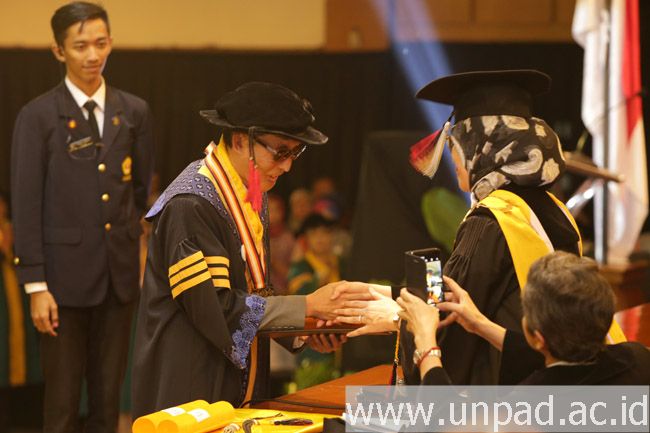
For example, the success of Dr. Rizki Harta Cipta graduated on time with Judiciary Cumlaude in the Doctoral Program in Law Science Unpad some time ago to prove that higher education is not limited to only certain groups. Even with limited vision, it did not become a barrier for Rizki to achieve.
Rizki is one of the disabled people who gives inspiration. Physical limitations are not an obstacle to pursuing dreams. With strong determination, they are able to achieve a good education and are able to devote their knowledge to the benefit of society. Therefore, the Government must continue to support it. *
Reported by Arief Maulana \ Translated by dfa