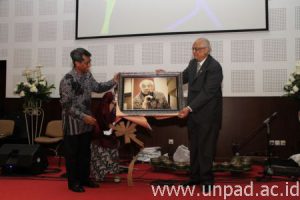
[Unpad.ac.id,26/04/2013] Unpad’s professor in Nuclear Medicine, Faculty of Medicine, Prof. Dr. Johan S. Masihur, dr., SpPD-KEMD., SpKN., gave a talk on nuclear medicine last Thursday (25/04) at the Unpad Teaching Hospital in Bandung.
According to him, begun in 1934 by the innovation of radionuclide, nuclear medicine is a product of multidisciplinary ideas gathered by biologists, physicists, chemists, pharmacists, engineers, microelectronicians, and medical doctors. “It enables doctors evaluate an illness up to its molecular level and prescribe specific medication and its effectiveness,” said he.
Latest innovation in this discipline is hybrid camera SPECT (Single Photon Emission Computed Tomography) and PET (Positron Emission Tomography) that can be used for molecular imaging in diagnosing illnesses.
“Molecular imaging aims at examining molecular growth of cells and body tissues in any living beings, including detecting the level of mRNA, protein, enzyme, and interactions among proteins,” said Masihur, who was born in Payakumbuh on February 28, 1942.
In Indonesia, nuclear medicine started in 1965. Not long afterward, its first reactor was erected and inaugurated by President Soekarno. However, due to numerous factors, it is paced at a very slow speed. The public still fear of the danger of nuclear for human life despite its extremely low radiation. “It is very low. Even lower than radiology treatment or external radiation therapy that has been going on for years,” he added. What’s more, to invest in nuclear medicine, one must understand the extremely high cost of providing nuclear medicine equipment. Indonesia is still facing malnutrition, infection, mother and infant prevalent diseases. Shifting focus toward nuclear medicine would mean a deviation from the country’s priority. Interest in nuclear medicine is also small. Financially speaking, practitioners in nuclear medicine make less than those practicing other specialties.
However, this must not be seen as a generator of pessimism in medical world. In time, nuclear medicine in Indonesia will reach its crest as doctors remain focused on developing it.