[Unpad.ac.id, 27/06/2013] Universitas Padjadjaran signed a Memorandum of Understanding (MoU) on Padjadjaran sheep development in West Java along with 11 agencies and academic institutions in West Java on Wednesday (06/26) at Executive Lounge of Unpad rectorate building, Bandung.
The MoU was signed by Unpad third vice-rector, Dr.med. Setiawan, dr., along with the representatives from Indonesian Ministry of Research and Technology, Animal Husbandry Department of West Java Government, Universitas Islam Nusantara, Universitas Islam Bandung, Universitas Jenderal Achmad Yani, Universitas Langlangbuana, Universitas Majalengka, Universitas Subang, Universitas Muhammadiyah Cirebon, PTPN VIII Sukawana Subang, and PT. Agro Surya Perkasa.
The purpose of this consortium is to promote Padjadjaran sheep breed as a major commodity in sheep husbandry business development, particularly in West Java. It can also be a road map in Padjadjaran sheep breed development project led by Prof. Sri Bandiati Komar, which focuses on the availability of high quality Padjadjaran sheep breed with low cholesterol meat to export.
The problem is that mutton production in West Java has not yet met consumer demand for meat. Nearly 80% of sheep farming industries in West Java are run by local farmers, which are primarily raising sheep only for meat, livestock, or manure. Therefore, sheep husbandry development requires availability of good sheep breeds, one of which is the Padjadjaran breed.
Another problem is that there has been a limited availability of well-tested cattle breeds that are good enough as mutton. Based on the data from the Directorate General of Livestock, in 2010 West Java was the region with the highest mutton production in Indonesia.
“West Java production of mutton is the highest in Indonesia, which reached 27258 tons. However, the consumption demand in West Java alone reached 344267 tons in the same year, ” said the secretary of Ministry of Research and Technology, Ir. Hari Purwanto, M.Sc., DIC., in between the event.
Hari further explained that Padjadjaran sheep development consortium is expected to encourage the quality improvement of sheep in West Java, which has the potential to be a highly valuable local product, and to overcome the problems surrounding sheep husbandry as well.
“I think each party can contribute to this consortium, so that it would help overcome the problems faced by sheep farmers, particularly in West Java, from upstream to downstream,” he said.
Dr. Setiawan also revealed in his speech that this cooperation in developing Padjadjaran sheep is important to overcome the various issues around sheep husbandry in West Java. Therefore, each party involved should facilitate the development by sending their researchers to contribute in the consortium.
“I think each party has given their commitment to this project. Now the problem is to establish a two-way communication between the researchers and the government in carrying out the project,” he said.
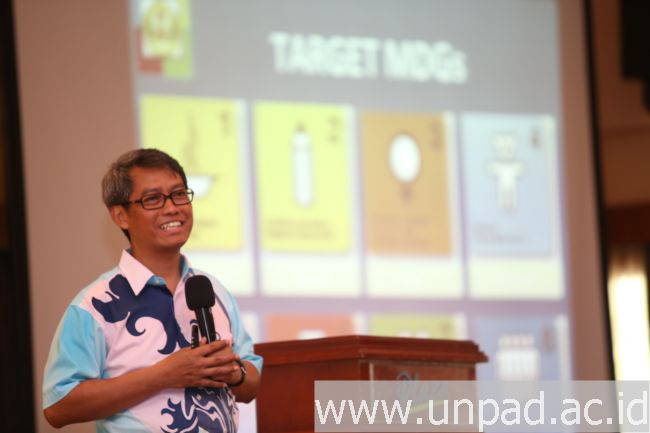
In addition to the signing of the MoU, at the event, a special presentation on the development of Padjadjaran sheep is given by Prof. Lamb. Sri Bandiati Komar. *