Reported by Salsabila Andiana
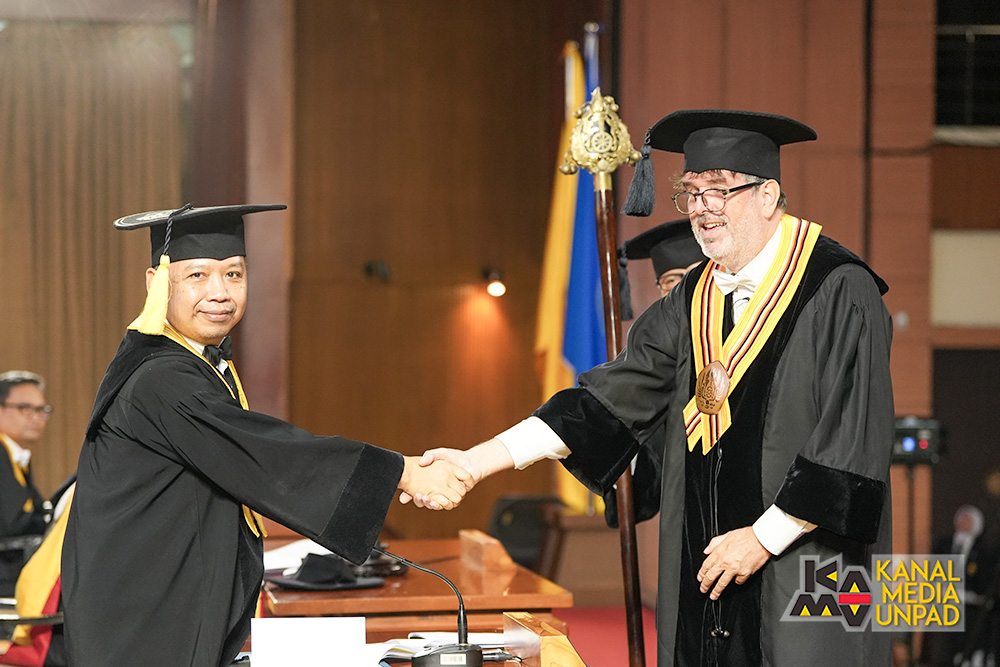
[Unpad Media Channel] Universitas Padjadjaran appoints an adjunct professor, Prof. Dr. Arnold Tukker, M.Sc., as a Professor in the field of Industrial Ecology at the Faculty of Economics and Business.
The appointment of Prof. Arnold is held in the Appointment Ceremony and Academic Oration for the Professorship, which is held at Grha Sanusi Hardjadinata Unpad, Iwa Koesoemasoemantri Campus, Bandung, Tuesday morning (28/5/2024).
Previously, Prof. Arnold was an Industrial Ecology Professor at the Institute of Environmental Sciences (CML), Leiden University, Netherlands. On that occasion, Prof. Arnold presents his academic oration titled “Exploring Strategies for Well-Being and Sustainability in Indonesia.”
In his presentation, Prof. Arnold explained how to develop evaluation systems that help Indonesia explore strategies for developing well-being for its citizens while doing so in a sustainable way.
According to him, large parts of the global population still do not have an income or access to education and health services that allow them to have a good Human Development Index (HDI). However, Indonesia has shown significant progress since the Asian financial crisis.
“Indonesia made incredible progress in growing GDP and improving HDI and conditions for its people.
Globally, some steps are needed to ensure that the global population is capable of living a good life without crossing social boundaries and to set up an economic system that delivers a good life for all who do not cross planetary boundaries.
Prof. Arnold said that Unpad, particularly its Faculty of Economics and Business is perfectly placed to address the issues. “Not only with regard to Indonesia but probably also at a more wider level,” said Prof. Arnold.
Moreover, Prof. Arnold explained that well-being can be analyzed through some perspectives, first, by using HDI as a parameter to calculate years of education, life expectancy, and income.
Until recently, many scholars use data about well-being that is self-reported or called “hedonic” well-being. Nonetheless, relying on self-reported well-being has limitations. “People can be manipulated and kept quiet,” stated Prof. Arnold.
Prof. Arnold hoped that the basic healthcare and access to universities like UNPAD would not be too much depending on income.
“That also people from poor families but who are bright can go and study,” said Prof. Arnold. He also hoped that Indonesia can develop while develop while maintaining its strengths.
Prof. Arnold added that using the input-output tables, scholars can also add data on carbon emissions, land use, water use, and other emissions of each sector as so-called extensions. Such databases have been made for Indonesia by Dr. Viktor Pirmana and Irlan Adiyatma Rum, ST., M.Sc. from the Faculty of Economics and Business at Unpad, who are also continuing their doctoral study at Leiden University.
Since a global input-output table follows economic relations from consumers back to all primary producers, this allows us to calculate environmental footprints. “In this way, we now can calculate the carbon, water, land, and material footprint of the total consumption per capita in a country for a specific year,” explained him.
There are two elements in the development of Indonesia into a sustainable well-being society: monitoring well-being and monitoring the life cycle and environmental impacts of consumption. Prof. Arnold believes that Unpad, especially the Faculty of Economics and Business, with the SDGs Center at Unpad, is well-placed to play a key role in achieving that matter. (arm/SA)*