[Unpad.ac.id, 22/12/2016] One important factor in determining the community prosperity in Indonesia is the aspect of employment. High unemployment rate will have an impact on increasing levels of poverty in the region. Educational level, the number of unemployed in West Java is largely dominated by elementary school (33.76%) and junior high school (23.27%) graduates.
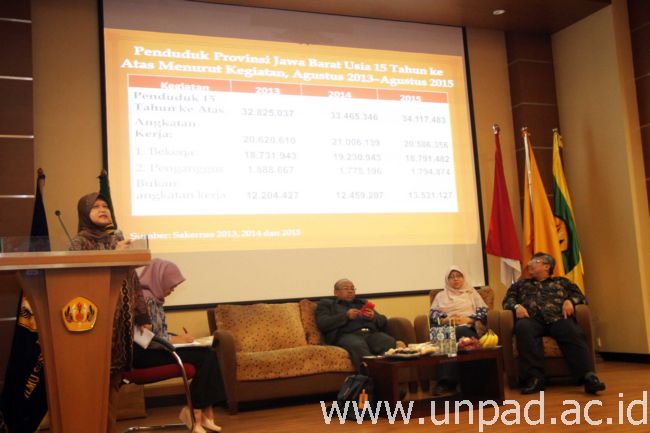
Said by expert of social development and welfare of children who is also lecturer department of Social Welfare Unpad, Dr. Nunung Nurwati, Dra., M.Si., as speaker in the National Seminar “Towards a Prosperous Indonesia” held by Study Program Social Welfare FISIP Unpad, in the auditorium of the Graduate Building Faculty of Communication Jatinangor, Thursday (22/12).
“If the Indonesian labor is prosperous, then the family and society as a whole will prosper,” said Dr. Nunung.
This seminar was held as the implementation of courses Profession Seminar of teaching Social Welfare by Dr. Soni A. Nulhaqim, S. Sos., M.Si. Besides Dr. Nunung, the seminar speakers were Head of Education, Research, Extension and Social Ministry of Social Affairs, Edi Suharto, PhD, Member of the House of Representatives Commission VIII Ledia Amaliah Hanifa, and social workers Drs. Tata Sudrajat, M.Si.
Dr. Nunung highlighted labor conditions in West Java. From the data of the National Labour Force Survey (Sakernas) in August 2013-August 2015, the number of labor force age (15 and over) in West Java is around 20-21 million people, with the number of people working in the numbers 18-19 million. Meanwhile the number of workers not from group of the labor force (aged 15 years and under) stands at 12-13 million.
 In August 2015, a total of 18 million working age labor force, approximately 49.61% worked in the formal sector, while the rest (50.39%) work in informal sectors. Dr. Nunung said that workers in the informal sector are mostly working in the sector of home-based businesses as well as unpaid work in accordance with the provisions of wages.
Although the unemployment rate is low, slightly by 1.8 million in 2013 and 1.7 million in 2015, Dr. Nunung said, there is no effective solution to empower the number of unemployed. If the unemployment rate is not significantly suppressed, the impact on the increase in poverty in West Java is alarming. Dr. Nunung said the development of education and human resources must be an active step for the provincial government in order for West Java to compete in the AEC era.
“What we are going to do with the (Figure)? If we want to compete in the AEC (ASEAN Economic Community), we will not be able to compete,” said Dr. Nunung.
Meanwhile, Edi Suharto said that although the poverty rate declined from 23.5% figure in 1999 to 11.5% in 2013, the growth of the national consumption rate is low and mostly dominated by the middle and high class. This causes the gini ratio (a measure of social inequality) in Indonesia is still high.
“Inequality is not a sign of prosperity. It is still a problem in Indonesia,” said Edi. *
Reported by Arief Maulana / eh