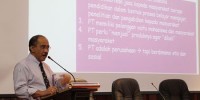
[unpad.ac.id, 10/29/2018] A number of professors from Unpad expressed their views on various findings of world scientists receiving the 2018 Nobel Prize at Unpad campus, Dipati Ukur Street No. 35, Bandung, Monday (29/10).

In the event held by the Unpad Professor Council, the professors discussed four 2018 Nobel fields, namely: Economics, Health, Physics, and Chemistry.
Prof. Dr. Armida S.Alisjahbana of the Faculty of Economics and Business became the discussent of the 2018 Economic Nobel Prize William Nordhaus and Paul Romer. The Nobel Foundation awarded two scientists from the United States for their consistency in integrating economics with other sectors.
“Both of them contributed to find the ways how to obtain sustainable economic growth. “They also take into account the causes of global market mechanism imperfections,” said Prof. Armida.
Prof. Armida explained, William integrates the impact of climate change with economic analysis. Departing from anxiety about climate change that occurred in America in the mid 1970s, he began to analyze the effects of air pollution and its impact on the economy.
Consistently, Willaim began researching this matter, including making three analysis modules, which included the carbon circulation module, climate module, and economic growth module.
He became the first scientist to integrate chemistry and physics with economics.
“He tried to apply the carbon taxes scheme, which is expected to reduce the impact of emissions. From there many studies refer to Nordhaus, “explained Prof. Armida.
While Paul discovered how innovation, science, and technology have an effect on long-term economic growth.
Paul departed from an understanding of the neoclassical economic model presented by economist Robert Solow. Neoclassical-style economic growth is exogenous with the influence of capital, law, labor, including technology.
However, the Neoclassical Solow model does not significantly promote long-term economic growth, especially in developing countries. Therefore, Paul modified it by emphasizing the need for innovation and science in economic growth.
Furthermore, Paul developed an endogenous economic model that is effectively implemented in developing countries.
The Nobel discussion in the field of health was delivered by the professor of the Faculty of Medicine Unpad Prof. Ramdan Panigoro. He discussed the discovery of new therapies for cancer treatment by two 2018 Nobel recipients namely James P. Allison and Tasuku Honjo.
As the second deadliest disease in the world, the development of massive cancer treatment is carried out by scientists in the world. During its development, cancer treatment began with surgery, radiation, and chemotherapy.
However, continued Prof. Ramdan, cancer treatment has its own impact on patients. This is what drived James and Tasuku to find cancer treatment methods by utilizing the body’s immune system to inhibit cancer cell growth.
James studied known proteins that function as brakes on the immune system. He realized the potential for brake release which meant releasing immune cells to attack tumor cells.
In parallel, Tasuku also found proteins in immune cells. After exploration of these cells that it also operates as a brake with a different working mechanism. Therapy based on their findings has proven to be very effective in combating cancer.
Professor of the Faculty of Mathematics and Natural Sciences Unpad Prof. Risdiana discussed the findings of Arthur Ashkin, Gerard Morow, and Donna Strickland, three 2018 Nobel laureates in Physics.
Arthur Ashkin, 96-year-old scientist received half of this year’s Nobel Physics Award. He was credited with finding “optical tweezers”, an invention of the use of high-strength laser light that is able to move particles, viruses, atoms, and other living cells.
Prof. Risdiana said, the discovery of Arthur seemed to be an embodiment that is always displayed in Western science fiction works, where the laser beam becomes the power to move certain particles. And Arthur was able to answer it.
“The point is that Arthur can show that with a certain focus of intensity, it can control and move particles,” said Prof. Risdiana.
While Gerard and Donna, these teachers and students discovered the use of lasers with the method of high intensity short optical pulse.
Both modified high-intensity laser devices without adding energy. This modification based on the vulnerability of the effects that occur when the laser energy increases when the intensity is increased.
From the discovery both of them produced high-intensity laser devices that are able to penetrate the surface without damaging it. This finding is certainly useful in the field of health, one of which is eye treatment through the lasik method.
Finally, the professor of Chemistry, FMIPA Unpad Prof. Dr. Toto Subroto discussed the findings produced by Nobel laureates in Chemistry, namely Frances Arnold, George Smith, and Gregory Winter. Frances got half of the Nobel award.
In essence, Frances’s findings produced a process of evolution of directed enzymes that are beneficial to life, including the production of environmentally friendly chemicals or renewable fuels.
“Enzymes are an important part or machine of life,” said Prof. Toto.
While George engineered bacteriophages, a type of virus that infects bacteria, to be developed into new proteins. Gregory used the phage display for antibody evolution with the aim of producing new drugs.
* Reported by Arief Maulana | Translated by dfa