[unpad.ac.id, 11/15/2018] The fourth era of industrial revolution (4.0) has a number of challenges. The readiness of the community to change is one of the biggest challenges that requires the support of parties.
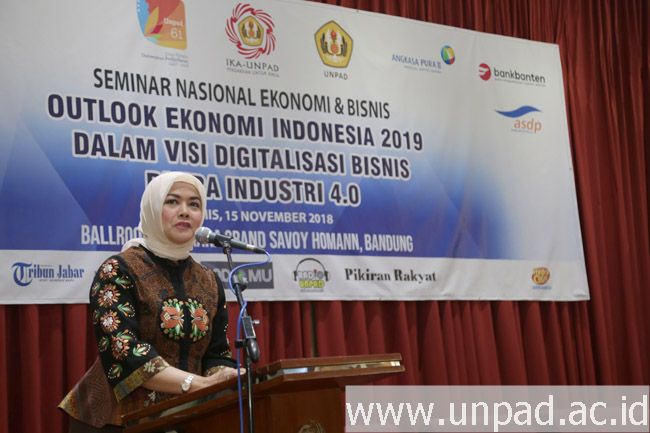
Vice Rector for Research, Community Engagement, Cooperation and Academic Corporations of Unpad, Dr. Keri Lestari, M.Sc., Apt. said that Indonesia has a number of challenges to adapt “smart society” as an embodiment of the 4.0 industrial revolution.
“Towards the era of 4.0, there was an era of agrarian society in the 18th century, 19th century industrial society, and information society in the early 20th century. Indonesia still has four eras,” said Dr. Keri when opening the national seminar “Indonesia Economic Outlook 2019 in the Vision of Digitizing Business in the Industrial Age 4.0” at Savoy Homann Bidakara Hotel, Bandung, Thursday (11/15).
She explained, a number of big cities in Indonesia might have entered the era of “smart society”. However, in some regions it could still be in the era of “agrarian society”.
This condition is different from other countries’. Dr. Keri took the example of how homogeneous the application of technology in agriculture in the United States. While in Indonesia, the application of technology in agriculture has not been evenly implemented.
“Thus, if you talk about digital business, don’t forget our society is still in the era of ‘agrarian society’,” she said.
Dr. Keri added academics were expected to contribute to bridge the gap between technological progress and society. This process is realized through the scientific implementation of academics.
For that, Dr. Keri expected academics and business people and other stakeholders to be able to develop a digital blockchain business model that connects the entire structure of Indonesian society, from “agrarian society” to “smart society”.
This model is expected to encourage the realization of “smart society” through the use of appropriate technology for each region.
“Indonesia is a diverse country, so it needs a special treatment and theory,” said Dr. Keri.
This national seminar was held in collaboration of Unpad Alumni Association with Unpad. The seminar presented key speakers Soerjono, Minister of Industry Expert Staff for Strengthening Industrial Structures and a number of speakers from alumni, academics and business people. *
Reported by Arief Maulana | Translated by dfa